
From a viral video and alleged abuse at sea to a wider investigation into fishing labour, vessel monitoring and fisheries governance
PELAKITA.ID – JAKARTA, Indonesia — A fishing vessel that left Jakarta in July has become the center of a widening investigation after allegations of violence against its crew emerged publicly, prompting Indonesia’s Ministry of Marine Affairs and Fisheries (KKP) and the Indonesian National Police to examine not only the alleged abuse, but also working conditions, recruitment, vessel monitoring and fishing operations aboard KM Maulana 23.
KM Maulana 23, an Indonesian-flagged vessel of approximately 89 gross tons, departed from the PPS Nizam Zachman fishing port in Jakarta on 15 July 2026. According to KKP’s vessel data, it was registered to operate with jala jatuh berkapal in fishing areas including WPPNRI 715 and 718 before heading toward the Arafura fishing grounds.
During the voyage, four crew members — Ilham Shalahudin, Oktavian Makhreza, Syawal Suswono and Johan Saputra — were identified as alleged victims of repeated physical violence.
Police are examining not only what allegedly happened aboard the vessel, but also communications between vessel management and the families of workers whose conditions became a matter of concern.
The investigation later found another potential fisheries-compliance problem. KKP’s examination of vessel movement data indicated that the Vessel Monitoring System, or VMS, was inactive from 22 August 2026. The finding expanded the case beyond labour protection, placing vessel monitoring, fishing permits, fishing gear and catch activities under regulatory scrutiny.
The case became public after footage allegedly showing violence against crew members circulated through social media. Indonesian police cyber patrol officers detected the material at approximately 02.00 WIB on 1 October, triggering efforts to identify the vessel, locate the alleged victims and coordinate the investigation between police authorities in Jakarta, the Aru Islands and KKP.
Four alleged victims were subsequently evacuated and taken to the Polres Kepulauan Aru for examination, while receiving medical treatment at RSUD Cendrawasih Dobo.
The intervention demonstrated the geographic complexity of maritime labour enforcement: the alleged abuse occurred offshore, while the response required coordination across distant government institutions and jurisdictions.
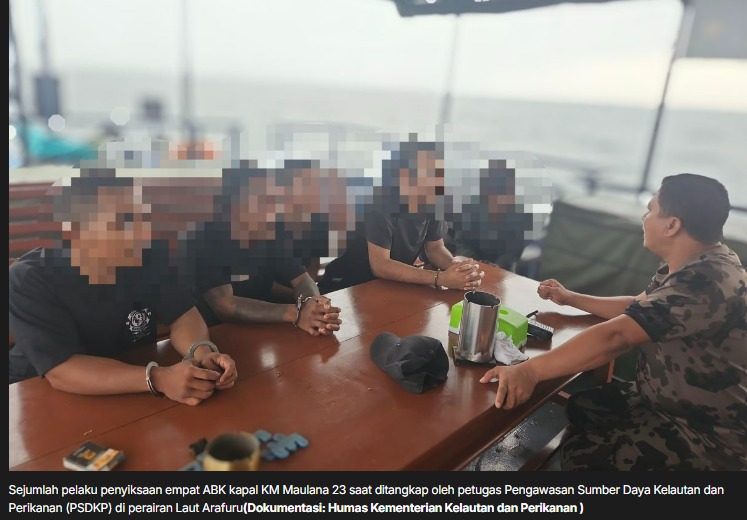
On 2 October, KKP patrol vessel KP Hiu 14 intercepted KM Maulana 23 in the Aru Sea at approximately 14.30 WIT.
The vessel was reportedly operating with pancing cumi, or squid fishing lines, carrying around one tonne of squid, and was subsequently escorted with its 28 crew members to the PSDKP working area in Dobo for investigation.
The following day, 24 people aboard the vessel were secured for questioning, although investigators stressed that being questioned did not automatically make someone a perpetrator or suspect.
KKP then formally announced its intervention on 4 October and suspended KM Maulana 23’s operational services, preventing the vessel from continuing its normal operational and sailing-permit processes through the e-PIT system while the investigation proceeded.
The labour dimension became increasingly serious as investigators examined crew accounts. KKP reportedly found allegations that workers were expected to meet squid-catching targets and could face physical punishment when targets were not achieved, while some reportedly worked from the afternoon until approximately 05.00 the following morning and received food only twice during the working cycle.
Pung Nugroho Saksono, KKP’s Director General of PSDKP, described the reported conditions as resembling slavery, while emphasizing that the legal determination remained under investigation.
The case has also expanded into possible human trafficking, with Polres Kepulauan Aru handling the alleged physical-abuse investigation and Polres Pelabuhan Tanjung Priok examining possible TPPO because the vessel departed from Muara Baru, Jakarta.
Investigators are examining recruitment and placement arrangements, including the possible involvement of recruitment agents.
KKP’s immediate administrative response has been the suspension of the vessel’s operational services and its continued examination by fisheries investigators. Officials have also stated that the vessel’s permit will be revoked, while the ministry has indicated that other vessels operated by the same company will be evaluated or audited, extending the investigation beyond a single vessel and its crew.
The significance of KM Maulana 23 therefore reaches beyond an alleged assault at sea. The case exposes the difficult intersection between fisheries governance and labour protection, showing how a vessel may possess formal fishing documentation while serious questions remain about working conditions, recruitment, catch targets, monitoring systems and the treatment of workers once the vessel leaves port.
For Indonesia’s emerging blue economy, this is a critical test. Sustainable fisheries cannot be defined only by fish stocks, legal fishing gear, vessel permits or electronic monitoring; sustainability must also include the workers whose labour produces the seafood entering domestic and international markets.
KM Maulana 23 has brought that invisible side of the seafood economy into public view.
Editorial Team