
By Kamaruddin Azis
Founder of Pelakita.ID and MaritimePosts.com
PELAKITA.ID — There are places that we simply pass through, and there are places that quietly become part of our life’s journey. For me, Bulukumba belongs to the second category.
My memories of this district stretch back to the period between 1996 and 2003, when I was a student of Marine Science and Technology at Hasanuddin University and as an NGO worker for LP3M Ujung Pandang at that time.
At that time, Bulukumba was not merely a destination. It was part of a long route that connected Makassar with Selayar and, ultimately, with the islands and marine landscapes of Taka Bonerate.
During those years, I travelled back and forth through Bulukumba countless times. My journey began as a student and continued through my professional work in Selayar, from my involvement in the WWF Project to the years of the World Bank-supported COREMAP programme.
In those days, travelling was itself an experience. I often took the Mahkota Bus, sitting for hours on the long road south, watching villages, rice fields, coastlines, markets and small towns pass through the windows.
I still remember Daeng Sikki, the driver.
Perhaps such memories may appear insignificant to others. But for those who have spent years travelling across the same roads, people and landscapes become part of the geography of memory. A driver, a bus stop, a roadside food stall or a familiar curve in the road can become a marker of an entire period in one’s life.
For me, Bulukumba was one of those markers.
A Return to a Different Bulukumba
Seeing Bulukumba again today, and comparing it with the Bulukumba I knew more than two decades ago, brings a strong sense of surprise.
Bulukumba has changed. Significantly.
The roads are better. Public infrastructure has grown. Functional buildings have appeared across the district. Urban spaces have become more organised and attractive. The city feels more alive, with business centres, cafés and commercial spaces becoming increasingly visible.
The Bulukumba of my memories was a town that I passed through, Bulukumba today is a town that makes me want to stop.
A few months ago, and again during my recent visit, I had the opportunity to observe this transformation more closely. One of the simple but meaningful moments was meeting old friends and fellow Marine Science alumni at Cafe Pihisi.
Reuniting with Jusli, Acil and Ardy was a reminder that time changes cities, but it also reconnects people. Conversations with old friends can suddenly bring back memories that have remained quietly stored for decades.
In the middle of those conversations, I found myself thinking: what a beautiful city Bulukumba has become.
Bulukumba, however, should not only be viewed as an administrative district. It has the potential to become one of the most strategic development hubs in the southern part of South Sulawesi.
Geographically and economically, Bulukumba sits within an important regional corridor connecting Sinjai, Bulukumba and the Selayar Archipelago. It has the potential to become an economic, service, logistics and knowledge centre for the wider southern region.
Its strategic advantage is supported by an extraordinary diversity of resources. Bulukumba has agriculture, livestock, fisheries and it has significant tourism resources. Few sub-districts possess such a broad spectrum of economic potential within one territory.
The challenge is therefore not merely how to develop each sector separately. The larger question is how Bulukumba can build connections between them and create a development ecosystem where agriculture, livestock, fisheries, tourism, trade, infrastructure, education and public services strengthen one another.
This is where the future of Bulukumba will be determined.
When Development Becomes Visible
One of the things that attracted my attention was the utilisation of Gedung Pinisi, not only as a representation of the district’s identity but also as an important public space and exhibition venue.
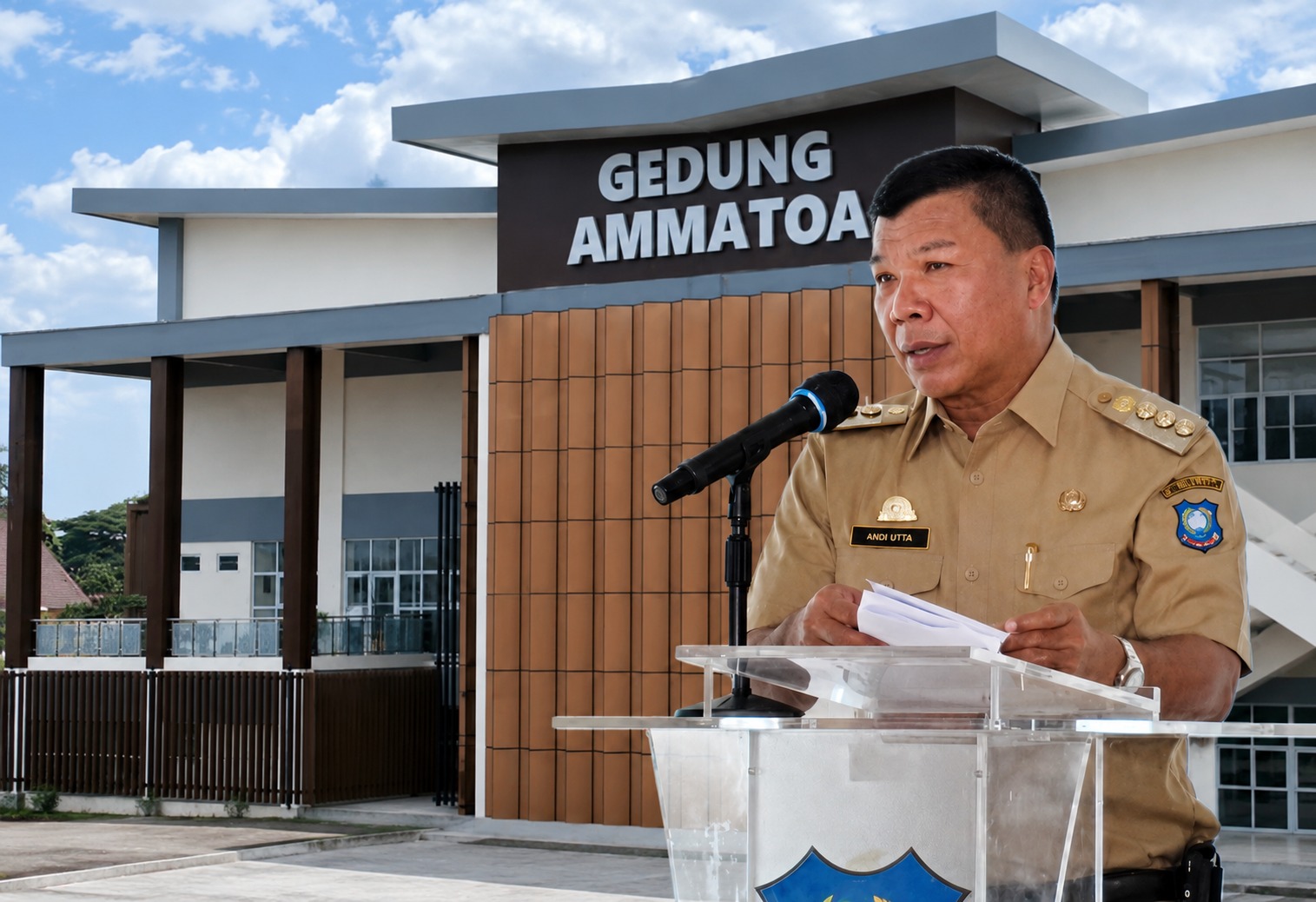
There is also Gedung Ammatowa, another sign of the expanding infrastructure and public facilities of Bulukumba. These buildings represent more than concrete, architecture and physical development. Their real value lies in how they are used.
Public infrastructure becomes meaningful when it creates interaction and utilized by the sectors of units under the government of Bulukumba.
A building becomes important when it supports creativity, meetings, education, exhibitions, business and collaboration.
Development, after all, should not be measured only by how many buildings are constructed. It should also be measured by how those buildings improve the quality of interaction among people.
During my visits, I could see many visible achievements that reflect the progress of the administration under Bupati Andi Utta. The physical transformation of Bulukumba is increasingly visible. Public spaces are improving. Economic activity is growing. The city is becoming more attractive and more functional.
Of course, every development story must be evaluated continuously. Progress is never a final destination. But from the perspective of someone who has known Bulukumba for decades, I can say honestly that the changes are significant.
Another important moment was the visit of the Rector of Hasanuddin University, Prof. Jamaluddin Jompa, and the meeting with Bupati Bulukumba Andi Utta.
For me, such meetings represent something bigger than a formal institutional agenda. They are a signal.
A signal that Bulukumba’s future development cannot depend only on government programmes or physical infrastructure. Knowledge, research, innovation and collaboration with universities will become increasingly important.
Universities can contribute research, Government can provide policy direction, communities can contribute local knowledge. Businesses can create investment and employment and the media can help build public awareness and accountability.
When these elements work together, development becomes stronger. Bulukumba has sufficient natural resources to grow. What it needs is increasingly sophisticated governance to ensure that growth does not create new social and environmental problems.
Beyond Infrastructure, the Challenge of Social Cohesion
Every successful development story eventually reaches a point where infrastructure alone is no longer enough. Better roads are important, modern buildings are important, growing businesses are important but development will face its most serious test when a society becomes more economically dynamic.
The next challenge for Bulukumba is how to strengthen social cohesion. How do people understand one another? How do communities from different social and economic backgrounds feel included in the development process?
How can public understanding grow regarding the consequences of development? How can people learn that the future of a district cannot be built by government alone?
Development requires collaboration.
It requires communities, government, business, universities, civil society and the media to work together. This is particularly important because rapid economic development often creates pressures that are not immediately visible.
More economic activity means more consumption, more businesses mean more waste. More visitors mean greater pressure on public facilities and natural resources. More development means increasing demand for water, land and energy.
Bulukumba must therefore begin to think not only about how to grow, but also about how to manage the consequences of growth.
Waste, Water and the Culture of Hospitality
Several strategic issues deserve serious attention. One is waste management.
As urban activity and tourism continue to grow, waste will become an increasingly complex challenge. The question is not simply where the waste should go. Bulukumba needs to think about waste reduction, sorting, collection, recycling and community participation.
The second issue is water resources.
Water is a fundamental requirement for households, agriculture, livestock, fisheries, tourism and industry. The future of economic development will depend greatly on how carefully water resources are protected and managed.
The third is something that may appear simple but is actually fundamental for a growing district: hospitality. If Bulukumba wants to become a regional hub, people will come from outside.
Students will come, researchers will come, investors will come, tourists will come. Government officials and businesspeople will come.
The question is whether Bulukumba is ready to welcome them—not only with infrastructure, but also with a culture of openness, service and hospitality. A beautiful city is not defined only by attractive buildings. A truly attractive city is one where visitors feel welcome and residents feel proud.
The Long Road of Memory
Dear readers, my personal relationship with Bulukumba has always been connected with movement. I passed through it as a student.
I passed through it while working in Selayar, through it while travelling to Taka Bonerate, through it during the years of WWF and COREMAP.
I travelled by bus. I watched the landscape from the window, met people. I remembered Daeng Sikki and the Mahkota Bus. Now, decades later, I return to see a Bulukumba that is no longer the same.
The roads have changed, the city has changed, the economy has changed and the infrastructure has changed. Perhaps the most important change is the growing possibility of what Bulukumba can become.
From my personal observations and experiences travelling across many districts over many years, I see significant progress in Bulukumba today. Comparing Bulukumba with the past is one way to appreciate its transformation.
Comparing Bulukumba with other districts is another way to understand its potential but ultimately, the future of Bulukumba should be measured against its own possibilities. Those possibilities are considerable.
The challenge now is to ensure that economic progress is followed by environmental responsibility, social understanding and stronger collaboration. Because development is not only about building a more beautiful city.
It is about building a society capable of protecting, managing and sustaining that beauty together.
A City That Makes Me Want to Return
Perhaps that is my strongest impression of Bulukumba today. Years ago, Bulukumba was a place I passed through on the way to somewhere else. Today, Bulukumba has become a place where I want to stop. To meet old friends, to observe change, to talk about ideas and to enjoy its growing urban life.
The journey from 1996 to 2003 remains deeply embedded in my memory. Those years were filled with buses, long roads, fieldwork, diving, islands and marine conservation.
Today, in 2026, Bulukumba gives me another memory. The memory of a district that has moved forward. Not perfectly. No place is but significantly and with great potential for the future.
Bulukumba is no longer merely a passage to the south. It is increasingly becoming one of the destinations, meeting points and strategic centres of South Sulawesi’s southern corridor.
Dear readers, if the momentum of infrastructure development can be combined with strong social cohesion, environmental awareness, hospitality, innovation and collaboration, then the Bulukumba of tomorrow may become far more remarkable than the Bulukumba I remember from my journey three decades ago.
For someone who has watched this district change from time to time, from one journey to another, there is only one conclusion I can honestly make, Bulukumba has moved forward. I believe its most interesting journey may still be ahead.
___
Tamarunang, 4 September 2026
Kamaruddin Azis
Founder of Pelakita.ID and MaritimePosts.com