
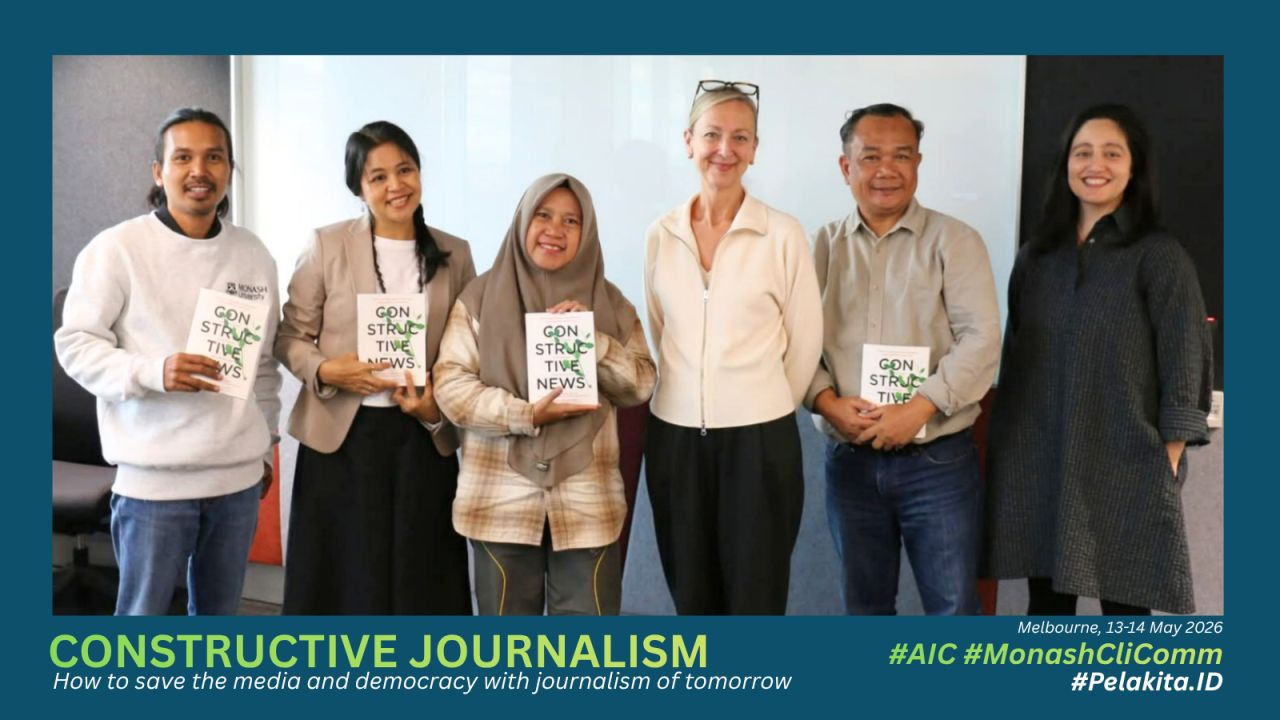
Global problems are complex, and journalism must become sophisticated enough to reflect that complexity without reducing everything into outrage, slogans, or ideological battles.
PELAKITA.ID – In a contemporary media landscape frequently defined by outrage, systemic pessimism, and a relentless focus on societal friction, Ulrik Haagerup’s Constructive News serves as a critical manifesto for structural reform rather than just another academic critique.
First published by Aarhus University Press in 2017, the book confronts a foundational premise of the modern press: the belief that audience engagement is strictly dependent on negative framing.
Drawing on extensive industry experience, Haagerup argues that a pervasive culture of negativity actively distorts public perception, erodes democratic institutions, and contributes to widespread psychological fatigue.
An Insider’s Critique of Media Culture
Haagerup’s arguments carry the weight of decades spent at the highest levels of European journalism.
Before establishing the independent Constructive Institute in Aarhus, Denmark, in 2017, he spent ten years as the Executive Director of News at the Danish Broadcasting Corporation (DR).
His career also includes tenures as editor-in-chief at prominent Danish newspapers, including Jyllands-Posten and Nordjyske.
Supplemented by executive education at institutions such as Stanford University, INSEAD, and the Wharton Business School, Haagerup combines theoretical depth with a direct challenge to deeply ingrained newsroom habits.
Rather than offering an abstract academic critique, the text represents an honest assessment of the industry by a veteran editor committed to its survival.
Diagnosing the Negativity Bias
The opening sections of the book examine the institutional preference for conflict and scandal, often driven by the traditional adage, “if it bleeds, it leads.”
Haagerup asserts that while journalism is intended to provide an accurate reflection of society, the contemporary press disproportionately amplifies failure while ignoring resilience, cooperation, and structural solutions.
The book introduces the concept of an informational “global mental obesity pandemic.”
Much like a poor diet impacts physical health, a steady consumption of high-conflict, low-context information degrades public discourse and emotional well-being, fostering cynicism and political polarization.
Haagerup’s critique highlights several systemic vulnerabilities in modern reporting:
-
The transition of journalism from a societal watchdog to a passive mouthpiece.
-
The rise of “hypothesis journalism,” where speculation supersedes rigorous verification.
-
The prioritization of profitable outrage over nuanced comprehension.
-
The dominance of superficial clickbait over substantive investigations.
Crucially, Haagerup does not advocate for naive optimism or sanitized reporting. Instead, he proposes constructive journalism—an approach that maintains rigorous, critical standards while actively investigating context, potential solutions, and future implications.
The Schmidt Preface: A Warning on ‘Media-Democracies’
A foundational element of the text is its preface, authored in October 2014 by the late Helmut Schmidt, former Chancellor of Germany and publisher of Die Zeit.
Schmidt elevates the discussion from a localized media critique to a broader political warning, arguing that Western nations have transitioned into “media-democracies.”
In these systems, the influence of mass media often eclipses traditional political leadership.
Schmidt notes that historical figures such as Winston Churchill and Charles de Gaulle, as well as the leaders of ancient Greece and Rome, governed long before the advent of the 24-hour digital news cycle.
Conversely, modern politicians are frequently forced to navigate a media environment that demands constant exposure, simplifies complex policy, and prioritizes emotional reactions over long-term strategy.
Schmidt specifically criticizes short-form communication, warning that reducing governance to tweet-sized slogans undermines democratic stability.
Writing at nearly 95 years old, Schmidt positions himself as a realist validating Haagerup’s optimistic effort to reform the industry.
A Pragmatic Framework for Reform
Unlike many texts that focus exclusively on media failures, the second half of Constructive News outlines practical applications for newsroom transformation.
Utilizing case studies from Danish and international media organizations, Haagerup illustrates how outlets can rebuild institutional trust.
The book details specific operational shifts required to change newsroom culture:
-
Formulating forward-looking, solution-oriented interview questions.
-
Balancing exposure of systemic failures with investigations into potential remedies.
-
Enhancing meaningful audience engagement over passive consumption.
-
Mitigating reflexive cynicism in daily reporting.
-
Realigning editorial priorities with journalism’s core democratic responsibilities.
Haagerup places significant emphasis on editorial leadership, arguing that shifting entrenched newsroom habits requires courageous management.
The concluding sections of the book frame this shift not as an isolated experiment, but as a growing international movement aimed at empowering citizens rather than exhausting them.
Contemporary Relevance and Final Assessment
A decade after its initial development, the core thesis of Constructive News remains highly relevant.
The proliferation of algorithmic polarization, disinformation, and clickbait business models has only worsened the structural issues Haagerup identified.
Globally, rising rates of news avoidance suggest that audiences are increasingly distancing themselves from media environments associated with helplessness and anxiety.
Haagerup does not suggest that the press soften its scrutiny of power, corruption, or conflict. Instead, he argues for a deeper, more responsible standard of reporting that supplements traditional investigative journalism with a fundamental question: “What now?”
Ultimately, Constructive News stands as an essential text for journalists, editors, policymakers, and media scholars. By merging practical newsroom experience with structural political critique,
Haagerup offers a viable roadmap for a profession facing a profound crisis of public trust, suggesting that journalism can still fulfill its civic purpose before being entirely overtaken by cynicism.
Epilog by Michael Moeller
In the epilogue of Constructive News, Michael Møller — Director-General of the United Nations Office in Geneva — elevates Ulrik Haagerup’s argument into a global democratic concern.
His essay, titled The Need for Media Empowerment, is not merely a closing endorsement of the book, but a profound reflection on the crisis of public trust, political disengagement, and the deteriorating quality of modern information ecosystems.
Møller begins by returning journalism to its highest ideal. Whether through newspapers, television broadcasts, digital platforms, or social media, the media exists to empower society.
Journalism, in its purest form, should help citizens understand the world, identify emerging global trends, engage critically in public debate, and hold power accountable. Democracy itself depends on informed participation. Yet empowerment, he argues, requires more than information overload. It requires facts, diversity of perspectives, context, and stories that inspire constructive action rather than emotional paralysis.
Then comes the central question that echoes throughout the epilogue: Are we getting that?
Møller’s answer aligns directly with Haagerup’s thesis: we are not.
Despite living in an age of unprecedented technological connectivity and unlimited access to information, millions of people feel increasingly powerless, disconnected, and alienated from public decision-making.
News consumers are overwhelmed by negativity, exhausted by conflict-driven narratives, and disappointed by political leadership. Instead of encouraging civic participation, modern media environments often deepen apathy and indifference. Møller describes this condition as a dangerous democratic deficit — not necessarily caused by censorship, but by disengagement itself.
This observation may be one of the book’s most important warnings. Democracies rarely collapse overnight. More often, they erode slowly when citizens stop believing their voices matter.
The epilogue also challenges the oversimplification that dominates much of contemporary communication.
Møller argues that the world can no longer afford one-dimensional narratives that ignore the deep interconnection between climate change, inequality, migration, conflict, economics, technology, and human rights.
Global problems are complex, and journalism must become sophisticated enough to reflect that complexity without reducing everything into outrage, slogans, or ideological battles.
This perspective resonates strongly in today’s digital age, where algorithms reward emotional reactions more than thoughtful understanding. Information may be abundant, but wisdom remains scarce.
From a United Nations perspective, Møller emphasizes that freedom of expression and access to knowledge are not abstract ideals; they are essential foundations for peace, human rights, and global well-being. Journalism therefore carries a responsibility far beyond producing headlines or generating traffic.
It shapes how humanity understands itself.
What makes this epilogue especially powerful is its tone. Møller does not reject criticism, investigative reporting, or accountability journalism. Instead, he calls for journalism that empowers rather than diminishes citizens — media that helps people imagine solutions, understand complexity, and remain engaged in democratic life.
Placed at the conclusion of Constructive News, the epilogue serves as both a warning and a hope. It reinforces Ulrik Haagerup’s central argument that journalism must move beyond the business model of fear and cynicism if democracy itself is to remain healthy.
In the end, Michael Møller reminds readers that the future of journalism is inseparable from the future of humanity.
___
Makassar, 28 May 2026
Written by K. Azis, founder The MaritimePosts.com and Pelakita.ID