
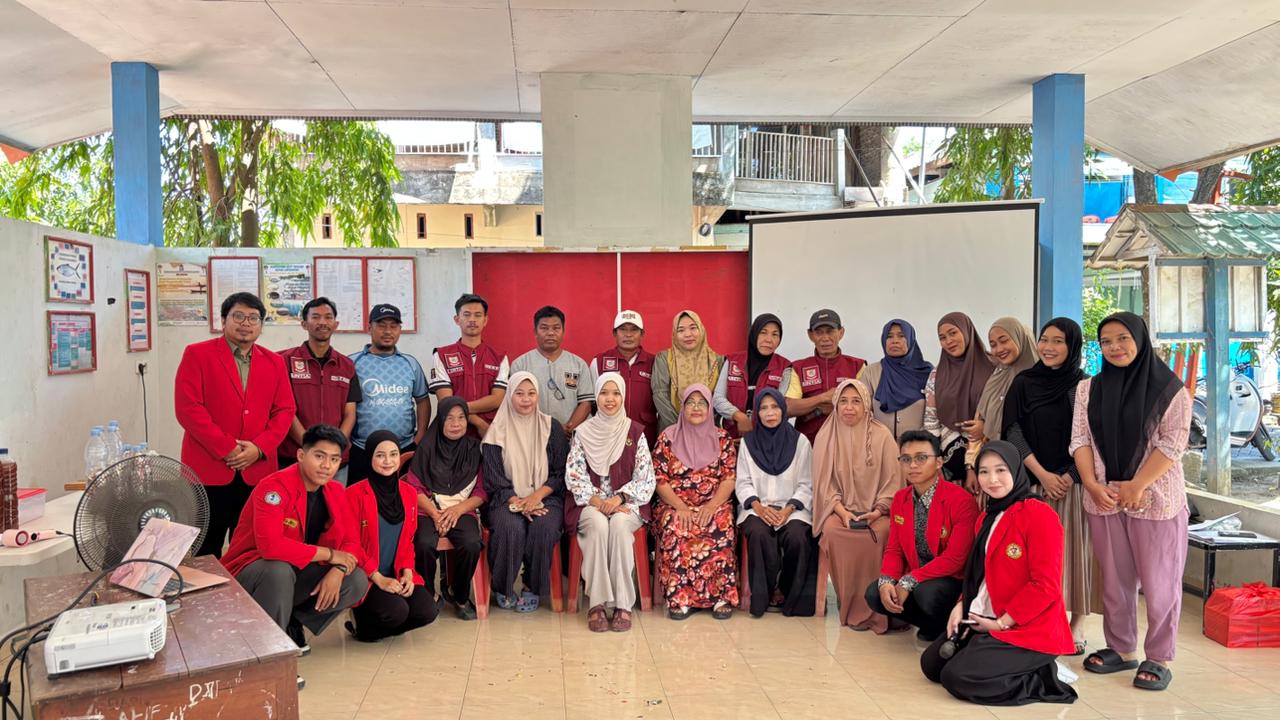
Through a collaboration between the Untia TPS 3R community waste management facility and a community engagement team from Universitas Hasanuddin (Unhas), local residents are learning to transform discarded plastic into ecobricks, creating a practical model of circular economy at the grassroots level.
PELAKITA.ID – MAKASSAR, Indonesia — In Untia, a small fishing village on the northern coast of Makassar, the sea has always been both a source of life and a source of uncertainty.
Every morning, fishermen head into the waters hoping for a good catch. Yet in recent years, another harvest has become increasingly common along the shoreline: plastic waste.
For the residents of this coastal community, plastic pollution is more than an environmental nuisance. It threatens marine ecosystems, reduces the quality of coastal habitats, and ultimately jeopardizes the livelihoods of families who depend on the sea.
Rather than accepting this growing problem as inevitable, the people of Untia are embracing an innovative solution—one that begins with something as simple as an empty plastic bottle.
Through a collaboration between the Untia TPS 3R community waste management facility and a community engagement team from Universitas Hasanuddin (Unhas), local residents are learning to transform discarded plastic into ecobricks, creating a practical model of circular economy at the grassroots level.
Rethinking Waste as a Resource
The initiative is part of a community service program titled “Development of a Circular Economy-Based Plastic Waste Management Model through Ecobricks at TPS 3R for Improving Environmental Health in Fishing Communities.”
At its core, the program seeks to change how people perceive plastic waste.
For decades, waste management has largely followed a linear path: consume, discard, and dispose. The circular economy proposes a different approach—keeping materials in use for as long as possible and extracting value from resources that would otherwise become waste.
In Untia, that transformation begins at home.
Residents are encouraged to see plastic packaging, wrappers, and bags not as useless trash but as raw materials that can be repurposed into durable and functional products.
According to Laksmi Trisasmita, leader of the Unhas implementation team, changing public perception is just as important as teaching technical skills.
“Plastic waste is an environmental problem that is very close to people’s lives, especially in coastal areas. Through this ecobrick training, we want to invite the community to see that plastic waste is not just waste, but can also be processed into something useful, valuable, and support a healthier environment.”
The message resonates strongly in a community where environmental quality and economic well-being are deeply interconnected.
The Simplicity Behind the Innovation
One of the strengths of the ecobrick concept lies in its simplicity.
Unlike many recycling technologies that require expensive machinery or specialized infrastructure, ecobricks can be produced using materials readily available in most households: plastic bottles, clean plastic waste, and a simple wooden or bamboo stick.
The process is straightforward yet surprisingly effective.
Plastic waste is first sorted, cleaned, and thoroughly dried to prevent decomposition or odors. It is then cut into smaller pieces and compacted tightly inside a plastic bottle. Over time, the bottle becomes densely packed, forming a solid building block that can be used for furniture, garden structures, decorative installations, and other community projects.
The hands-on nature of the training allows participants to learn every stage directly, building confidence and encouraging immediate application within their households.
For the Unhas team, this low-cost technology offers a practical solution that can be replicated in many coastal communities facing similar challenges.
Protecting the Ocean from the Shoreline
The impact of the program extends beyond waste reduction.
For fishing communities such as Untia, better waste management contributes directly to environmental health and marine conservation.
Every kilogram of plastic diverted from open dumping or waterways represents one less threat to fish populations, mangrove ecosystems, and coastal biodiversity.
Akbar Mallombasi, facilitator at the Untia TPS 3R facility, believes the initiative strengthens ongoing community-based waste management efforts.
“Training like this is very important because it provides practical skills for both residents and TPS 3R workers. We hope ecobricks can become an alternative method of plastic waste management while opening opportunities to create useful products from discarded materials.”
The initiative also aligns closely with several United Nations Sustainable Development Goals (SDGs), including good health and well-being, sustainable cities and communities, responsible consumption and production, and life below water.
For Untia, these global goals are not abstract international commitments; they are directly connected to everyday realities.
Cleaner neighborhoods reduce health risks. Better waste management creates more resilient communities. And preventing plastic pollution helps safeguard the marine environment that supports local livelihoods.
From Ecobricks to Economic Opportunities
The vision for the project extends well beyond producing bottles filled with plastic.
The next phase of the program focuses on transforming ecobricks into functional products with social and economic value. Community benches, garden installations, educational facilities, and other practical structures are among the possibilities being explored.
According to Taufiqurrahman Zulkifli, a member of the implementation team, demonstrating tangible benefits is essential to sustaining community participation.
“This training does not stop at making ecobricks. In the future, the ecobricks that have been made will be directed into products that can be utilized so that the community can see real results from the circular economy-based plastic waste management process.”
By creating visible outcomes, residents can witness how waste can be transformed into assets that contribute to community development.
The approach not only reduces environmental pressure but also opens opportunities for local innovation and entrepreneurship.
A Model for Coastal Resilience
The partnership between Universitas Hasanuddin, TPS 3R Untia, and local residents illustrates how universities can work alongside communities to address complex environmental challenges through practical solutions.
Rather than relying solely on large-scale infrastructure or costly technologies, the initiative demonstrates the power of community participation, behavioral change, and local innovation.
In Untia, environmental stewardship begins with everyday actions: sorting plastic, cleaning bottles, and carefully compressing waste into a new form.
Each ecobrick represents more than a recycled bottle. It symbolizes a shift in mindset—from disposal to reuse, from pollution to opportunity, and from environmental vulnerability to resilience.
As villagers sit together filling bottles with discarded plastic, they are not merely managing waste. They are building a future where coastal communities can protect their environment while creating value from what was once considered worthless.
Sometimes, the foundations of sustainability are not built from concrete and steel.
Sometimes, they begin with a single bottle.
(MP)