
A collaboration between local government, private stakeholders, and experts from the Pangkajene Kepulauan State Agricultural Polytechnic (Politani Pangkep) introduced structured agricultural training to farmers. Under technical guidance, including mentors such as Pak Kadir, farmers transitioned from traditional methods to science-based cultivation.
PELAKITA.ID – In the rugged highlands of Barru, South Sulawesi, coffee has long been part of the landscape—though historically more as a botanical accessory than an economic asset.
For decades, coffee trees were treated as side crops or simple yard plants, grown casually near homes just enough to supply household cups.
While neighboring regions such as Toraja and Kalosi built strong global reputations and premium market positioning, Barru’s coffee remained an overlooked secret, quietly cultivated across areas like Pujananting and Tanete Riaja.
By June 2026, however, that quiet presence has begun to evolve into a coordinated transformation.
Following a strategic initiative led by the Regent of Barru, Andi Ina Kartika Sari, and the involvement of the CIDES ICMI team, the region is undergoing a deliberate agricultural shift. The goal is ambitious: to develop more than 1,000 hectares of highland areas into a premium coffee corridor.
This is no longer just an agricultural story. It is a case study in how a region—once overshadowed by established coffee giants—can reposition itself through community-driven development and government facilitation to enter the specialty coffee market.
From Side Crop to Strategic Investment
The most profound change in Desa Harapan is not occurring in the soil, but in the mindset of its farmers.
H. Baharuddin, Chairman of the Lajoangin Coffee Group, notes that the old approach treated coffee as a passive resource: a few trees planted with minimal management and limited expectations.
Today, that mindset has shifted. Farmers are beginning to view coffee as a long-term strategic investment. Supported by local government vision and community leadership, coffee cultivation is no longer incidental—it is becoming intentional and organized.
The Lajoangin Coffee Group has grown to nearly 70 active members managing approximately 61 hectares of land. This expansion aligns with the broader regional vision to develop coffee production zones stretching from Pujananting to Tanete Riaja.
Sustainable rural transformation rarely comes from introducing entirely new commodities. It comes from revaluing existing but underutilized resources.
By reframing coffee from a “yard plant” into a strategic asset, Barru has unlocked a new trajectory of rural economic growth without the burden of starting from zero.
“Coffee has been here for a long time. Almost every house has coffee trees, but only as yard plants. Now people are beginning to see coffee as a real business opportunity.” — H. Baharuddin
Knowledge is More Valuable Than Capital
The acceleration of the Lajoangin Coffee Group began in August 2025. Importantly, the catalyst was not large-scale funding, but knowledge transfer.
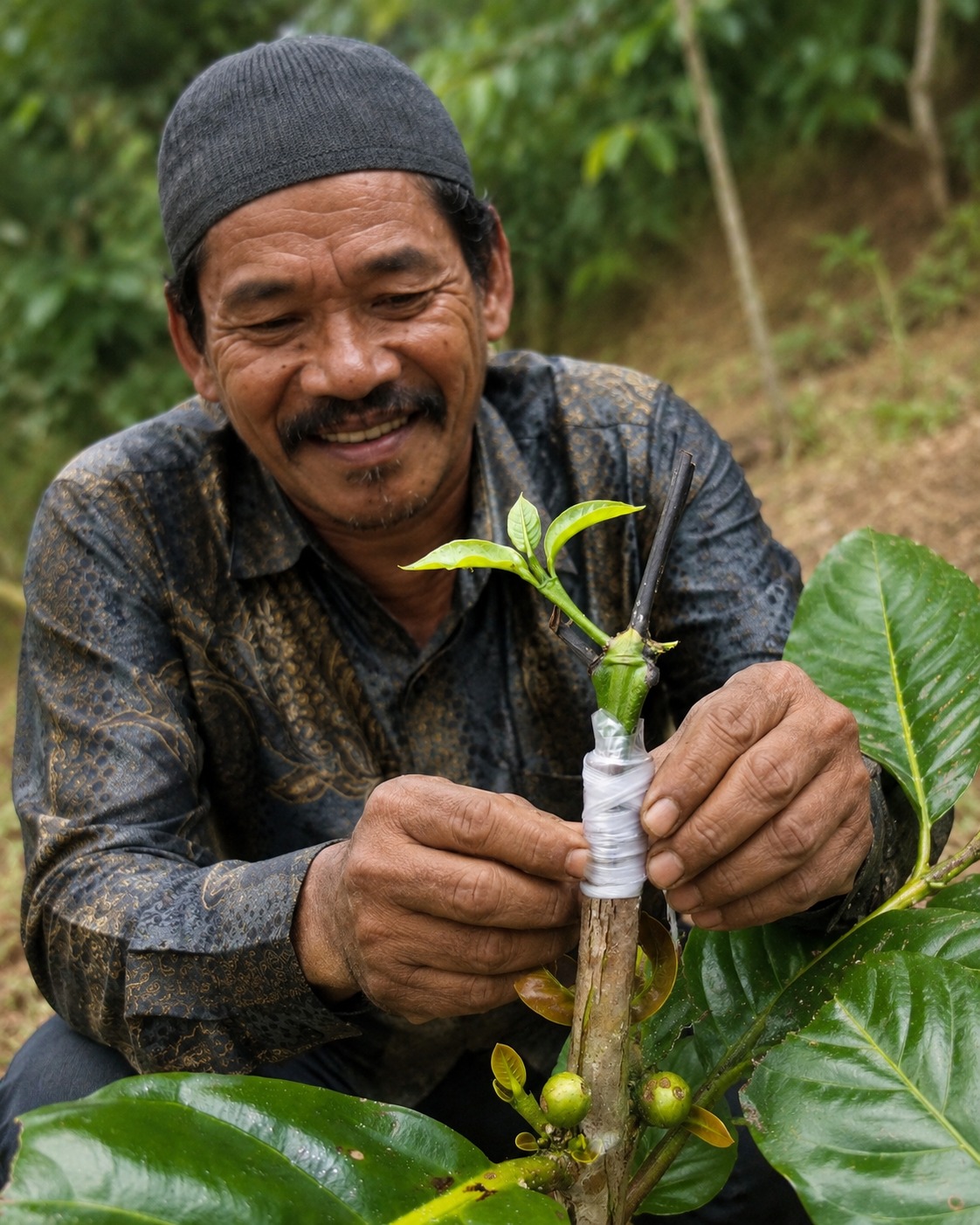
A collaboration between local government, private stakeholders, and experts from the Pangkajene Kepulauan State Agricultural Polytechnic (Politani Pangkep) introduced structured agricultural training to farmers. Under technical guidance, including mentors such as Pak Kadir, farmers transitioned from traditional methods to science-based cultivation.
Training covered:
- Scientific nursery management and seed selection
- Precision pruning techniques to optimize cherry production
- Post-harvest handling, including fermentation control and drying standards
This shift marked a major turning point—from intuition-based farming to technically guided agriculture.
“The assistance we received is extraordinary. If this knowledge had to be paid for like formal education, the cost would be very high. They came bringing expertise we did not previously have.” — H. Baharuddin
The Discovery of the “Quality Multiplier”
Markets are not uniform—they are hierarchical. For years, Barru farmers operated at the lowest tier, selling standard-grade coffee to collectors at modest prices. Today, they are beginning to understand what can be called the “Quality Multiplier.”
They are realizing that Barru’s Robusta and Arabica varieties are genetically comparable to those grown in more established regions such as Toraja. The key difference lies not in the plant, but in processing discipline and post-harvest management.
Currently, farmers benchmark dry Robusta prices at around 60,000 IDR/kg. However, a major limitation remains: the absence of local processing infrastructure. Beans must still be processed at external facilities such as Politani Pangkep.
Rather than discouraging progress, this limitation has become a driving force for future investment in local processing capacity.
The transition from farming to agricultural entrepreneurship happens when farmers realize that value is not only created in cultivation, but in post-harvest transformation. Processing is the true equalizer in specialty coffee markets.
The Return of the Next Generation
One of the most significant changes in Tanete Riaja is the gradual return of younger generations to agriculture. This reversal of rural outmigration is driven not by sentiment, but by transparency and opportunity.
In the past, coffee trade was opaque, controlled by local middlemen. Today, direct market linkages, private partnerships, and improved access to pricing information are changing that structure.
With government facilitation and investor engagement, farming is increasingly perceived as a modern, data-informed enterprise rather than a subsistence activity. The introduction of scientific methods and improved market access has reduced the stigma of agriculture among young people.
As a result, more youth are returning to rural areas, seeing coffee farming not as traditional labor, but as an emerging agribusiness opportunity.
The Geographical Indication Ambition
Long-term branding is now a central objective. The Lajoangin Coffee Group is actively pursuing Geographical Indication (GI) status.
In the global specialty coffee industry, origin is a form of value. A recognized geographical identity ensures that economic benefits remain within the producing region while strengthening market recognition.
As Arabica cultivation expands alongside established Robusta production, Barru is building a more diverse coffee profile capable of competing in the broader specialty market.
“Hopefully, one day our coffee will have Geographical Indication status. So when it is sold outside the region, people will know it is coffee from Harapan, from Barru.” — H. Baharuddin
Leading by Example (The Two-Hectare Proof)
In rural transformation, leadership credibility is proven through action. H. Baharuddin embodies this principle through his personal two-hectare coffee plot, which serves as a living demonstration site.
Drawing on experience from integrated farming systems in Banyuwangi, he applies environmentally friendly practices and reduces reliance on chemical inputs.
This experimental plot functions as a “proof of concept” for the wider community.
Farmers tend to trust what they can see. By demonstrating tangible results on his own land, Baharuddin transforms abstract training into visible, replicable practice. Combined with technical support from agricultural experts, this approach accelerates adoption across the community.
In rural development, demonstration is more powerful than instruction. Visible success reduces risk perception and builds collective confidence.
A Future Brewing in the Hills
As of mid-2026, Barru’s highlands are in a state of transition. Thousands of newly established coffee trees are still in early growth stages, and the community continues to address challenges such as limited processing infrastructure.
Yet despite these constraints, optimism has already taken root.
Under the leadership of Regent Andi Ina Kartika Sari and local community figures such as H. Baharuddin, Barru has moved decisively from treating coffee as a backyard plant to positioning it as a frontier economic sector.
With coordinated government support, knowledge transfer, and shifting farmer mindsets, Barru is actively reshaping its agricultural identity.
As these young coffee trees continue to grow, one question remains: what other “backyard resources” in rural communities are still waiting to be transformed into engines of economic change?
___
Written by Kamaruddin Azis