
PELAKITA.ID – The development of Artificial Intelligence is no longer merely a technological discourse; it has become a force reshaping how humans communicate, produce information, and shape public opinion.
Amid this shift, the line between fact and manipulation is increasingly blurred, raising fundamental questions about ethics and legal protection.
In practice, AI enables automated content production, message personalization, and even the creation of synthetic realities such as deepfakes. While this ease opens up vast opportunities for the media and communications industry, it also introduces new risks, ranging from disinformation to privacy violations.
These challenges demand an approach that is not purely technological, but also normative. An ethical perspective is essential to ensure that the use of AI remains grounded in values such as truth, transparency, and accountability. At the same time, legal frameworks must be adaptive to keep pace with rapidly evolving innovation.
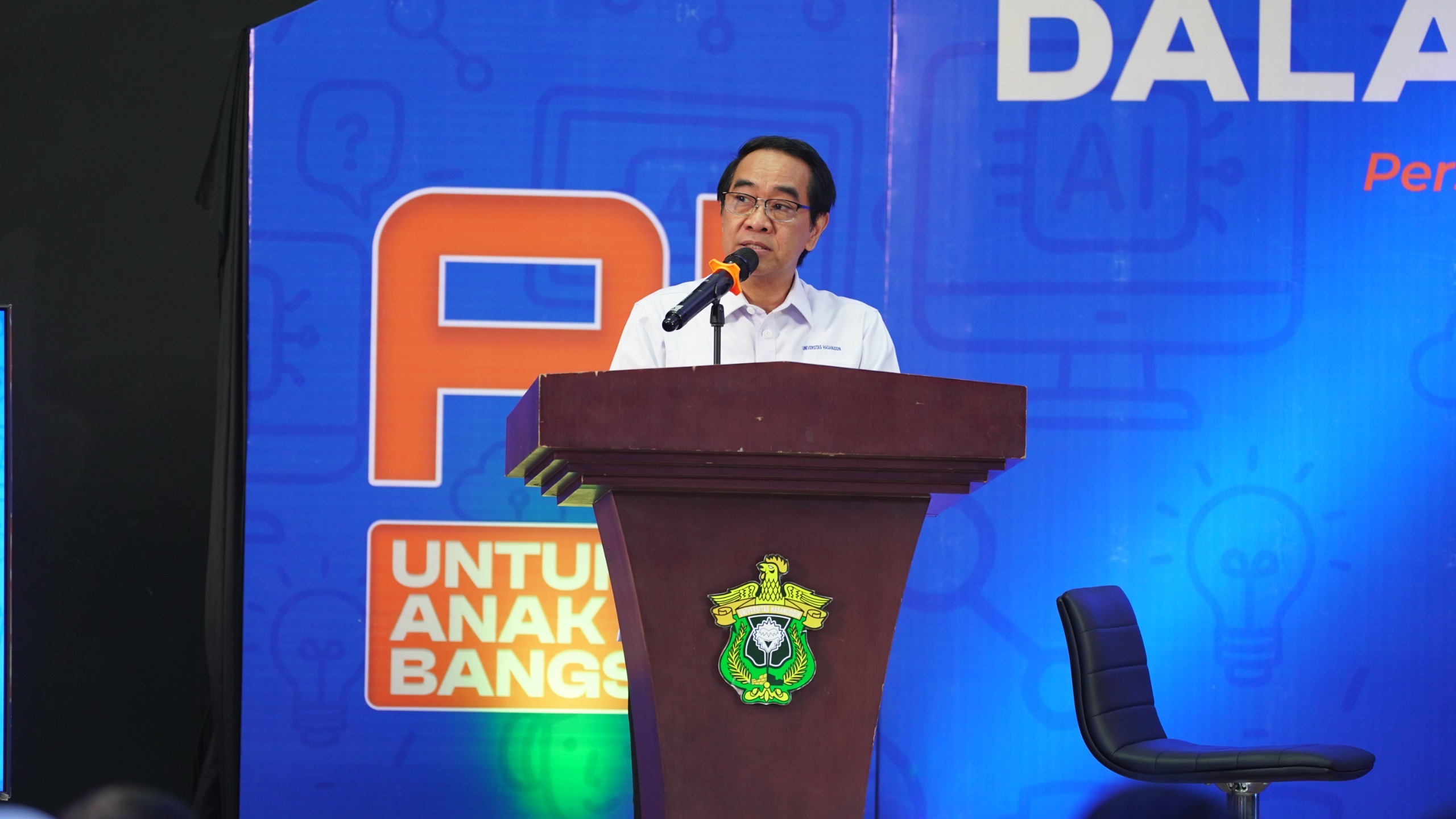
Awareness of this complexity has encouraged various stakeholders to open spaces for public dialogue. One such initiative was the talk show titled “AI for the Nation’s Future”, organized by Unhas TV in collaboration with TV Tempo, held at the Main Studio of Unhas TV, BRI Microfinance Building, 2nd Floor, Monday (April 20).
The Rector of Hasanuddin University, Prof. Dr. Ir. Jamaluddin Jompa, M.Sc., explained that universities play a strategic role as centers of knowledge production as well as guardians of values. Unhas places digital literacy as a key component in preparing students to face technological disruption. He emphasized the importance of balancing technological mastery with ethical awareness.
“Students, as the younger generation, must be able to understand and use this technology wisely for the future,” Prof. JJ stated.
From the media industry perspective, Anton Aprianto, Director of TV Tempo, views AI-driven transformation as inevitable. According to him, adaptation to technology must go hand in hand with improving public literacy. He stressed the importance of collective awareness in responding to this disruption.
“AI offers many benefits, but it also brings challenges that must be understood together. Through this forum, we aim to build broader public awareness,” Anton explained.
Following the opening remarks, the session continued with presentations from several speakers: Prof. Yudho Giri Sucahyo, S.Kom., M.Kom., Ph.D., CDPSE, CEH, CISA, CISM (Professor at the Faculty of Computer Science, University of Indonesia), Dr. Hasrullah, MA (Lecturer in Communication Studies), and M. Reza Suarga (AI Content Creator).
During the session, the speakers highlighted the rapid advancement of AI technology, which has actually existed since the 1980s, but has only experienced significant growth and widespread adoption in today’s digital era. (*/mir)