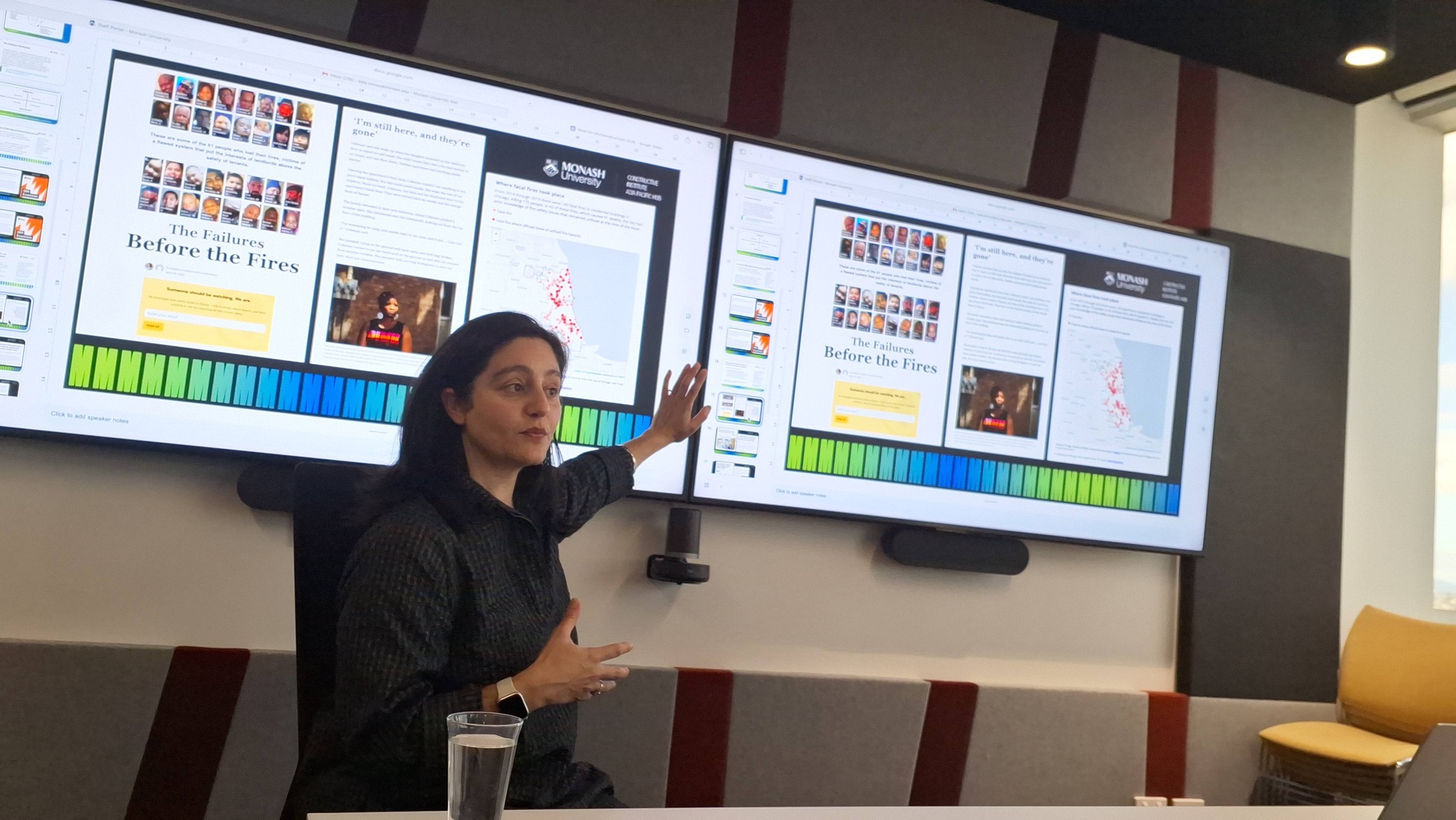
Stephanie Brookes, who currently serves as Deputy Director of the Constructive Institute initiative at Monash. (image by K. Azis)
Without facts, you can’t have truth. Without truth, you can’t have trust. Without trust, we have no shared reality — and democracy cannot function. Constructive journalism takes all the basic principles of journalism — asking who, what, where, and why — but it also goes a step further to ask: what’s next?
PELAKITA.ID – Last week, Monash Climate Change Communication Research Hub hosted a two-day knowledge-sharing workshop in Melbourne, bringing together Indonesian and Australian journalists, climate scientists, communication experts, and researchers from 13–14 May 2026 to strengthen collaboration and improve climate reporting across the region.
The program was part of the “Supporting Climate Reporting in Indonesian Newsrooms” project, conducted in collaboration with the Australia-Indonesia Centre and funded by the Australia Indonesia Institute.
Participants discussed climate science, future projections, effective climate communication, misinformation challenges, and approaches to constructive journalism that help audiences better understand solutions.
The workshop also explored how Australian journalists report on climate and energy issues, as well as the importance of international collaboration in climate reporting.
Indonesian climate research case studies were presented to strengthen scientifically grounded and community-focused journalism.
Following the Melbourne sessions, the research team continued their work in Makassar to share findings from the broader study and help develop tools and strategies for more timely, accurate, and impactful climate reporting in local communities.
On the second day, Kate Torney, Executive Director of Constructive Institute Asia Pacific, described Constructive Journalism as an approach that seeks to transform the way journalism serves society — not by ignoring problems, but by reporting them with depth, evidence, context, and a future-focused perspective.
According to Torney, journalism today must move beyond simply highlighting conflict, crisis, and division. It should also help communities better understand challenges, explore possible solutions, and feel more informed and empowered to respond.
She expressed her enthusiasm for establishing the Constructive Institute in Australia, Asia, and the Pacific, based at Monash University in collaboration with Constructive Institute.
The initiative aims to strengthen a constructive approach to news coverage that is evidence-based, solutions-oriented, and focused on the future.
Torney emphasized that such an approach has never been more important, especially at a time when societies across the world are facing complex issues including climate change, misinformation, social polarization, and public distrust in media.
Before joining Monash, Torney led the Peter MacCallum Cancer Foundation, supporting one of Australia’s leading institutions in cancer care, treatment, and research. Prior to that, she served for seven years as Chief Executive Officer of the State Library Victoria, where she oversaw a major transformation of library services and public spaces through an AU$88 million redevelopment project. Under her leadership, the library became one of the most visited libraries in the world, attracting around 11 million visits annually. Torney also brings more than 25 years of experience in journalism and media. She worked as a journalist, producer, editor, and executive producer before becoming News Director at the Australian Broadcasting Corporation from 2009 to 2015.
During that period, she led a nationwide newsroom team of 1,500 staff across Australia and 11 international bureaus, while overseeing the rapid expansion of digital news services and the launch of ABC News 24.
Her experience across journalism, public institutions, and social communication has shaped her belief that journalism should not only inform audiences, but also contribute to stronger, more resilient, and more engaged communities.
Process and messages from the workshop
Constructive Journalism and the Search for Hope in Today’s Media Landscape
In an era when audiences are increasingly overwhelmed by conflict-driven headlines, political polarization, and endless streams of information, a growing movement in global journalism is asking a different question: not only “What happened?” but also “What next?”
That was the central message shared during a recent workshop on Constructive Journalism held at Monash University, bringing together journalists, researchers, academics, and media practitioners from Indonesia and Australia.
The discussion was led by Kate Torney, former News Director of the Australian Broadcasting Corporation, alongside journalism scholar and researcher Stephanie Brookes, who currently serves as Deputy Director of the Constructive Institute initiative at Monash.
For Torney, whose journalism career spans more than 27 years, constructive journalism is not about avoiding problems or turning news into “positive stories.”
Instead, it is an approach that seeks to strengthen journalism’s public role by adding depth, nuance, accountability, and pathways toward solutions.
“Constructive journalism takes all the basic principles of journalism — asking who, what, where, and why — but it also goes a step further to ask: what’s next?” Torney explained during the workshop.
Beyond Conflict and Polarization
According to Torney, much of today’s media environment is dominated by polarized reporting that frames issues as endless battles between opposing sides.
“You have one person on this side, another person on that side, and a fight — and that’s all,” she said. “Whereas for us, we feel we need to offer audiences more than that.”
Constructive journalism attempts to shift reporting away from outrage-driven narratives toward stories that still critically examine problems while also exploring responses, ideas, and possibilities.
The approach, developed through collaboration with the Constructive Institute, focuses on three key principles: solutions, nuance, and conversation.
Rather than presenting the world in black and white, constructive journalism seeks “the best available version of the truth” by exploring complexity, context, and multiple perspectives.
“It’s journalism for tomorrow,” Torney said. “Instead of only looking back at what happened, it asks what could happen next, and how communities can move forward.”
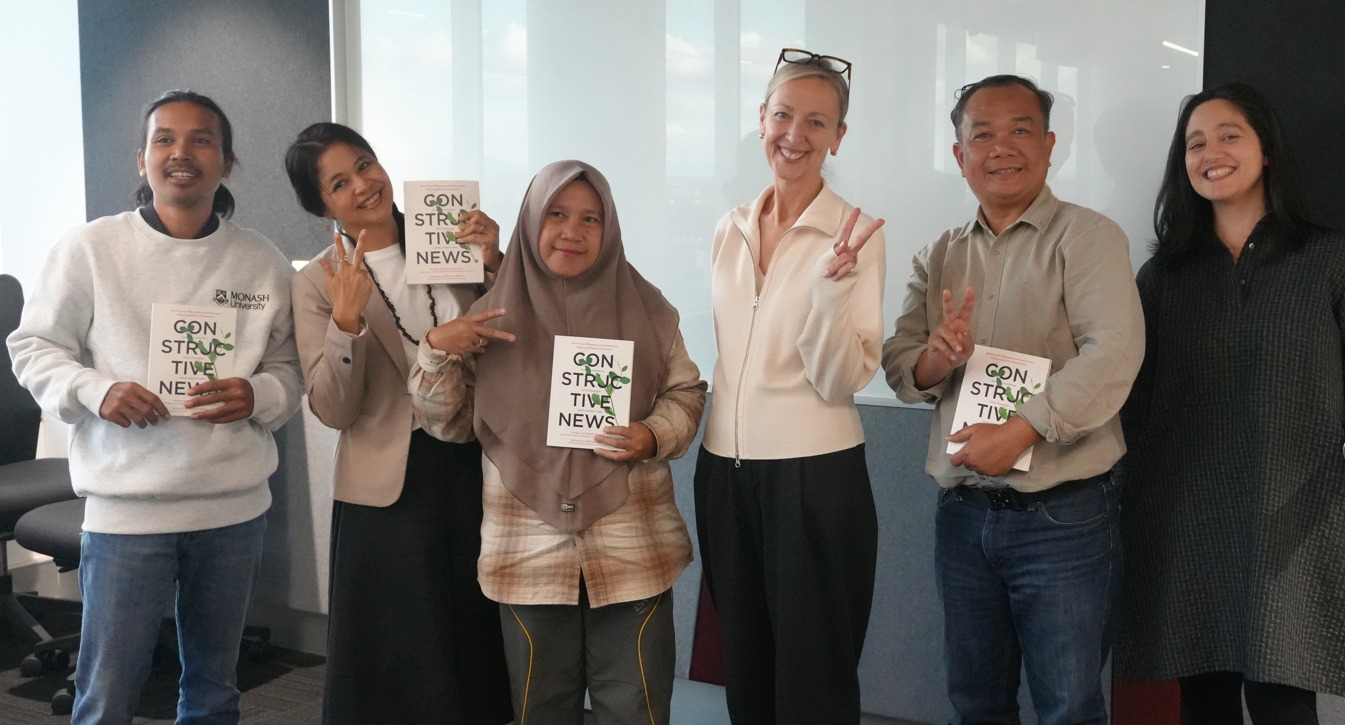
Participants of the workshop and resource persons, Kate Torney and Stephanie Brookes (image by Pelakita.ID)
Journalism Without Losing Its Watchdog Role
One of the strongest points emphasized during the workshop was that constructive journalism is not activism, public relations, or soft journalism.
Participants discussed concerns often raised by reporters: whether focusing on solutions risks weakening journalism’s critical role in holding power accountable.
Torney rejected that assumption.
“Constructive journalism retains the watchdog role and the accountability role of journalism,” she said.
She quoted journalist David Bornstein of CNN, a leading advocate of solutions journalism, who argues that reporting on solutions can actually sharpen journalism’s investigative power.
“When you incorporate solutions journalism into your reporting, it sharpens the teeth of the watchdog,” Torney said. “Because leaders can no longer say, ‘We can’t do better.’”
By showing examples of communities, institutions, or countries attempting to solve similar problems, journalists remove excuses often used by political leaders or policymakers.
The discussion resonated strongly with participants from Indonesia, where many journalists acknowledged the challenges of producing in-depth reporting amid shrinking newsroom budgets, pressure for speed, and competition from social media influencers.
Several participants noted that hard news formats often prioritize conflict, sensationalism, and short quotes over deeper exploration of issues and possible responses.
News Fatigue and Public Distrust
The workshop also addressed a growing global phenomenon: news avoidance.
Torney cited findings from the Reuters Digital News Report and research from the University of Canberra showing that large numbers of audiences — especially younger people — are disengaging from news because it negatively affects their mood, feels overwhelming, or appears disconnected from their daily lives.
“There’s too much coverage of wars and conflict, too much politics with people shouting at each other,” she said.
Participants from Indonesia agreed that audiences increasingly avoid stories dominated by political conflict or environmental disputes because they feel there are no solutions and no meaningful outcomes.
“If all people hear is conflict, they become confused about what to believe,” one participant said during the discussion.
The consequences of this trend, Torney warned, are serious.
Without trusted, evidence-based journalism, societies become more vulnerable to misinformation, manipulation, and unverified content circulating online.
She referred to the well-known statement by Filipino Nobel Peace Prize laureate Maria Ressa:
“Without facts, you can’t have truth. Without truth, you can’t have trust. Without trust, we have no shared reality — and democracy cannot function.”
The Need for Hope in Journalism
Another major theme in the workshop was the importance of hope — not false optimism, but realistic hope grounded in evidence and human possibility.
Torney argued that journalism often overlooks stories of resilience, adaptation, and innovation because traditional news values prioritize crisis and failure.
But by ignoring these dimensions, journalism may be presenting only part of reality.
“People cannot move forward if they lose hope,” she said, referring to comments from speakers associated with the Nobel Peace Center in Denmark.
Constructive journalism therefore encourages reporters to ask different questions during interviews. Instead of focusing only on anger or outrage, journalists can also ask sources what they believe should happen next.
“If all we do is reward outrage, then we end up with stories full of angry people,” Torney explained. “But many of those people are leaders who are actually responsible for solving problems.”
The goal, she said, is not to silence criticism, but to encourage accountability alongside problem-solving.
Relevance for Indonesian Journalism
For Indonesian participants, the workshop sparked important reflections about the future of journalism in the country.
Some journalists noted that media organizations increasingly struggle to fund investigative and long-form reporting, while audiences consume more information through social media platforms and influencers.
Others discussed the limitations faced by citizen journalists and freelance contributors whose stories are often reduced to very short formats that leave little room for context or deeper voices from communities.
Yet many participants agreed that the principles of constructive journalism could help rebuild public trust and make journalism more relevant, especially for younger audiences who are exhausted by negativity and political polarization.
At the end of the session, Torney showed an image of a public bench outside the Nobel Peace Center designed in a way that physically prevents people from sitting far apart from one another.
For her, the sculpture symbolized the deeper purpose of constructive journalism.
“It’s trying to bring people together to have hard conversations,” she said. “Not to avoid the big issues, but to help societies engage with them more constructively.”
In a media landscape increasingly shaped by speed, outrage, and division, the workshop offered a different vision of journalism — one that still investigates, questions, and challenges power, but also helps audiences imagine what comes after the conflict.