
PELAKITA.ID – Amid the chaos triggered by severe floods and landslides in Pidie Jaya, Aceh, a medical emergency unfolded that tested the limits of local health facilities.
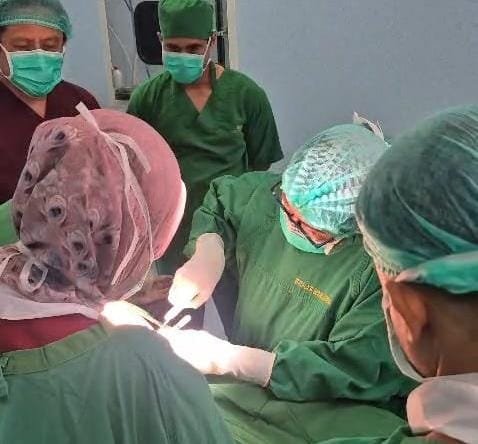
On the night of 3 December 2025, a team of doctors from Universitas Hasanuddin (Unhas) carried out a series of emergency caesarean operations that ultimately saved the lives of three pregnant women and their newborns.
The hospital where they operated — RSUD Pidie Jaya — was itself affected by the disaster: access routes were disrupted, medical personnel were exhausted, and resources were stretched to their thinnest point.
The first patient arrived with a combination of life-threatening complications. She suffered from severe pre-eclampsia, maternal obesity, and premature rupture of membranes that had lasted more than 24 hours.
Any delay could have led to fatal consequences for both mother and child. The second mother required immediate surgery due to her previous caesarean history and a dangerous fetal position — the baby lay sideways in a transverse lie, making normal delivery impossible. The third patient, too, was battling severe pre-eclampsia, a condition known for its rapid escalation and high risk of maternal mortality.
Working in a disaster zone, with limited staffing and heightened pressure, the Unhas medical team moved swiftly. Despite the challenges — from unstable electricity to a shortage of rested specialists — they performed all three emergency procedures consecutively. Their rapid response paid off.
The three babies, two boys and one girl, were born safely with promising Apgar scores of 7/9. While one newborn required further monitoring in the treatment room, all were reported to be in stable condition. Their mothers, too, survived the ordeal, receiving post-operative care while the disaster response continued around them.
The intervention of the Unhas medical team was not merely clinical; it was an act of humanitarian solidarity.
Many of the hospital’s own obstetric and pediatric staff were themselves victims of the floods and landslides — some had lost homes, others had been working nonstop for days. By stepping in, the Unhas doctors provided critical relief, taking over essential emergency duties at a moment when the local system was at a breaking point.
In the midst of destruction, this story stands as a reminder of the resilience and compassion that surface in times of crisis.
As Pidie Jaya grapples with damaged homes, disrupted communities, and a long recovery ahead, the survival of these mothers and newborns offers a symbol of hope — proof that even in the darkest hours, timely action and collective care can bring new life into the world.
Unhas Team