
PELAKITA.ID – The rapid growth experienced by Ecuador’s shrimp industry in the late 1990s came to an abrupt and devastating halt at the turn of the new century.
The cause was not economic turbulence or market failure, but a biological catastrophe far deadlier than the previously known Taura Syndrome Virus. White Spot Syndrome Disease (WSSD) swept through Ecuadorian shrimp farms with the force of a plague, fundamentally reshaping the industry.
First identified in Thailand in 1990, the white spot virus proved extraordinarily lethal. Within as little as seven days, infected shrimp populations were virtually annihilated.
The disease manifested through extreme lethargy and abnormal feeding behavior, followed by the appearance of characteristic white spots on the shrimp’s exoskeleton. By the year 2000, the impact on Ecuador was catastrophic.
Shrimp export revenues collapsed from USD 617 million in 1999 to just USD 297 million—a decline to 48 percent of the previous year’s value.
Mortality rates were staggering, and farms that managed survival rates of 10 percent were considered fortunate. Bankruptcy and business closures became widespread, forcing a painful large-scale restructuring of the sector.
Recovery was slow and uncertain. Many producers never returned to operation, while those that survived struggled to rebuild production capacity under far more cautious and risk-averse models.
Pre-2000 production levels were not restored for several years. By 2005, Ecuador’s shrimp export volume reached 213 million pounds (approximately 97 million kilograms), equivalent to only 77 percent of the 1999 level.
Compounding the challenge, global shrimp prices were under increasing pressure due to rising production from Asian competitors. It was not until 2008 that Ecuador finally surpassed its pre-crisis export value, reaching USD 673 million.
The rebound accelerated in the following years. By 2011, Ecuador achieved a historic milestone, recording shrimp exports valued at USD 993 million—exceeding the previous peak of USD 875 million reached in 1998.
A new boom had begun, built on lessons learned from the industry’s near collapse. Central to this revival was not only improved disease management but also a strategic shift in production philosophy.
One of the most significant trends to emerge was the move toward organic and certified shrimp production. Beyond offering product differentiation and better pricing, organic production methods emphasized stricter biosecurity, lower stocking densities, and enhanced environmental control—factors that contributed to improved disease prevention.
Among Ecuador’s major exporters, at least two companies explicitly integrated organic production into their core business strategies. Because organic certification requires comprehensive oversight from hatchery to export, this shift also accelerated vertical integration across the value chain.
By 2013, industry concentration had become pronounced at the processing and export level. Approximately 97 percent of Ecuador’s Litopenaeus vannamei shrimp exports were handled by the country’s seven largest processors and exporters, placing this segment of the industry firmly within the definition of an oligopoly.
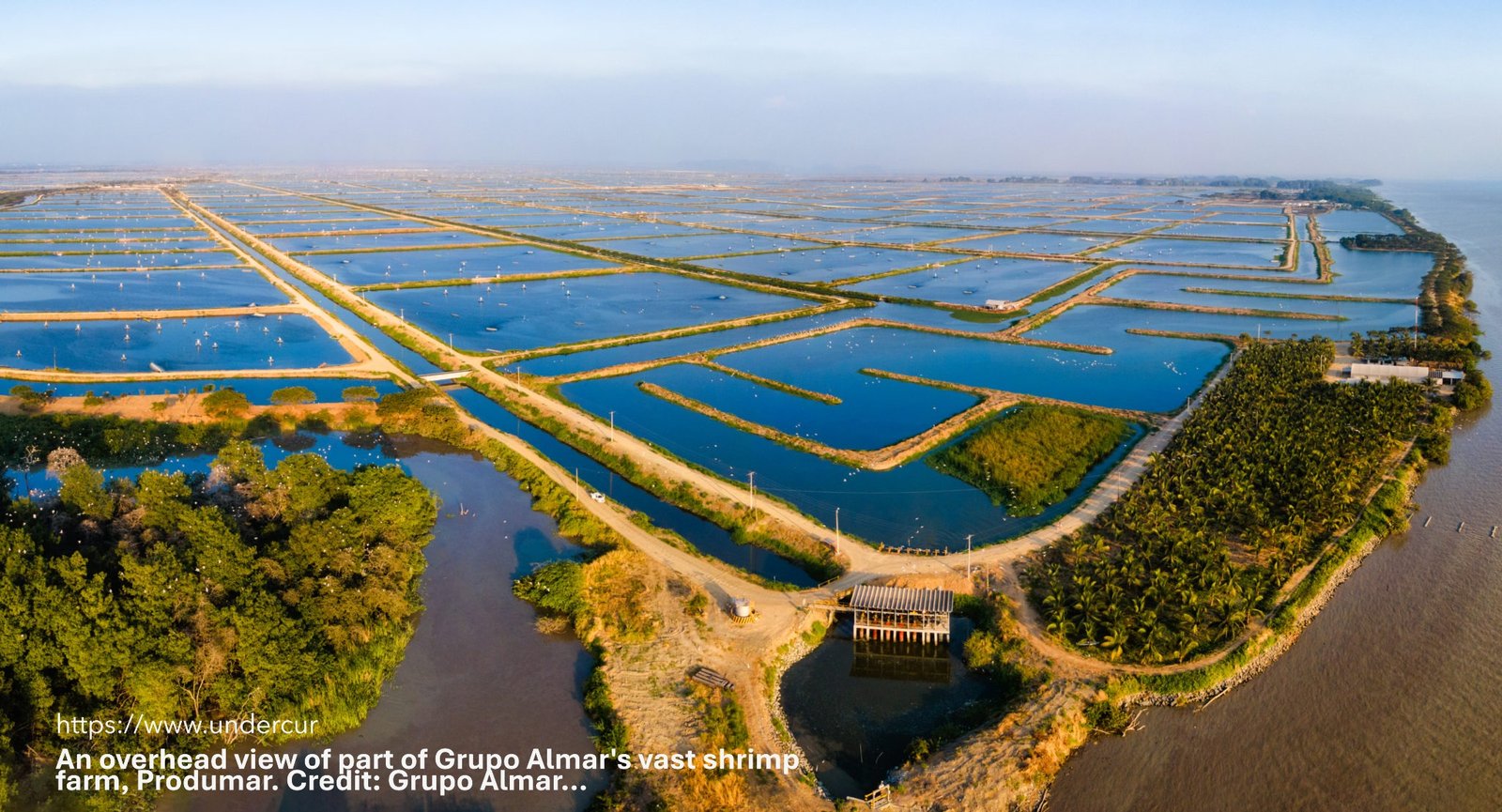
In contrast, production power remained more dispersed, shared among hundreds of independent shrimp farmers alongside large, vertically integrated farms operated by major corporate players.
Looking ahead, one factor with the potential to significantly reshape the industry is the global restructuring of the Spanish seafood company Pescanova.
Following its insolvency, uncertainty surrounds the future of its Ecuadorian subsidiary, Promarisco, which until 2013 controlled a substantial share of shrimp exports.
The fate of its assets—including thousands of hectares of shrimp farms—remains unresolved, and how these resources are redistributed could influence Ecuador’s shrimp industry for years to come.
Source: