
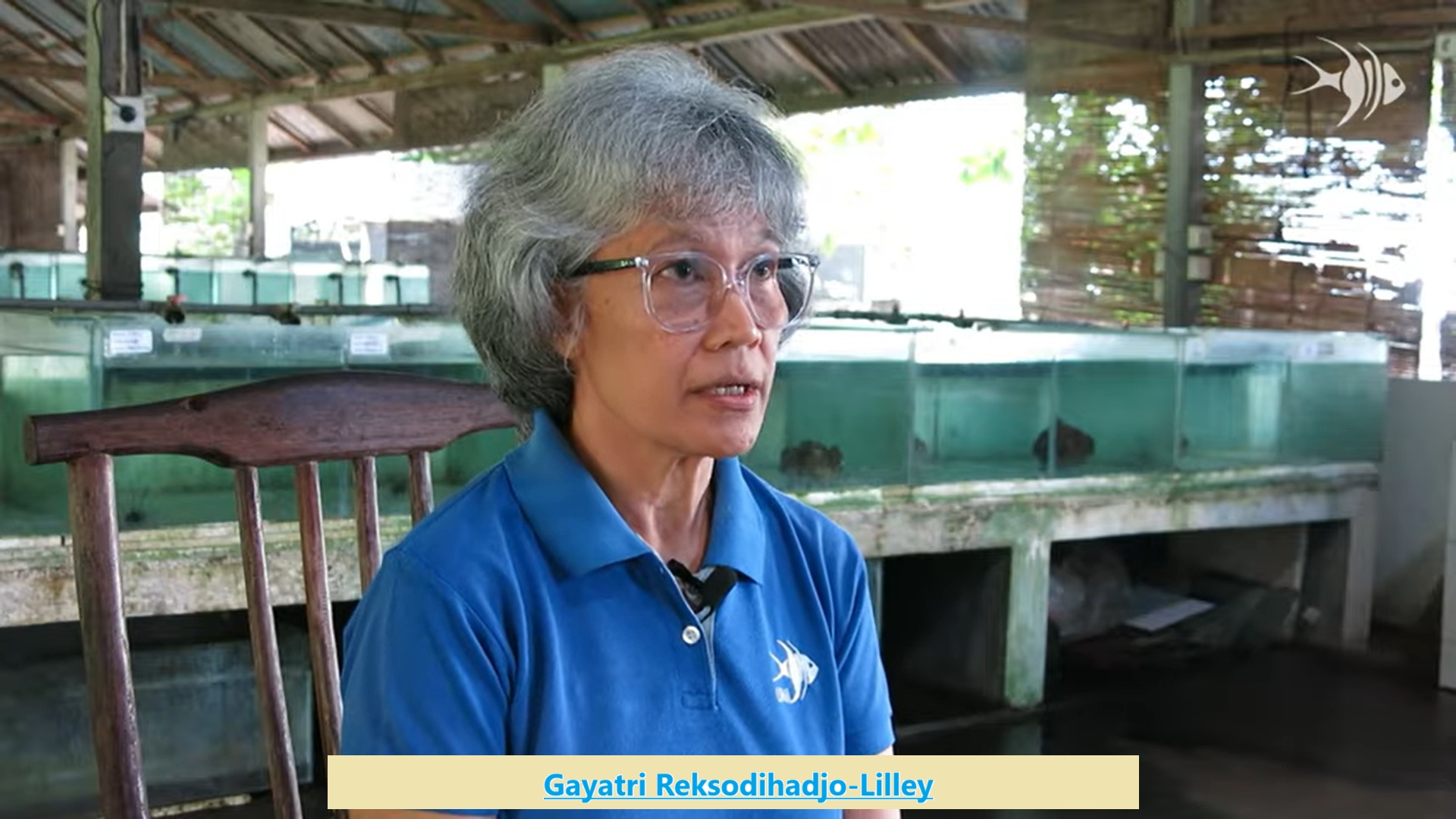
Gayatri led initiatives that placed fishers, local residents, and vulnerable groups at the center of conservation. She worked in coastal villages, training communities to manage coral reefs, make decisions, and become guardians of the sea in their own homeland.
PELAKITA.ID — There is a name that has long stayed with me—a name I first came across in an old report I read in the early 1990s. At that time, I had just completed my studies in Marine Science and Technology at Hasanuddin University in 1995.
I moved from campus life to the coastal villages of Taka Bonerate, learning to understand the world of conservation, and came upon an EMDI Canada document about the world’s third-largest atoll: Taka Bonerate.
In that report, among the long list of researchers, scientists, and conservation practitioners, one name made me pause: Gayatri Reksodihardjo-Lilley.
Back then, Taka Bonerate had just been declared a National Park (1992). Her name was unfamiliar to me; yet for the local community, it already carried a warm and honorable resonance.
Years later, as I began sailing more frequently to Rajuni Island in Taka Bonerate, I heard for myself how tenderly people spoke her name.
“Ibu Gayatri is kind… caring… friendly… and she understands us.”
That was how Haji Darwis, Pak Haya, and Pak Coang—the Bajo elders I greatly respect in Rajuni—described her.
Through their stories, I understood how pivotal Gayatri was in bringing Taka Bonerate to the world’s attention.
She was not merely a researcher; she was a bridge—one who opened the way for scholars, conservation organizations, and international programs that would soon arrive in the years that followed.
Her work shed light on the destructive fishing practices that were once widespread in the atoll.
Today, my friends, sad news reached me from our colleague Yunaldi Yahya: Mother Gayatri has passed away. Innalillahi wa inna ilaihi rajiun.
Remembering Gayatri is, for me, also remembering my own friends—those who walked the path of conservation inspired by the same spirit.
Their names now form a mosaic of memory: the late Ramli Malik, Boyke Lakaseru, Putu Widiastuty, Ivan Firdaus, Syafyuddin Yusuf—those who fought for conservation under WWF Indonesia in the 1990s.
There were also those involved in the Giant Clam Translocation Project in Taka Bonerate, a landmark effort that marked a new chapter for the protection of giant clams: Mas Kun Praseno, Andi Nurjaya Nurdin, Syafruddin Tara, Ahmad Madonk Thamrin, and Kemal Rahman Massi.
From many accounts, I know that the major breakthroughs achieved through WWF and LP3M Ujung Pandang at the time were deeply influenced by the encouragement and spirit Gayatri sowed.
Last year, I finally met her—a moment that felt like completing a long circle of journeys and unanswered questions about her work in Taka Bonerate, a region where I worked from 1996 to 2003 without ever meeting her once.
We met during a Sustainable Fisheries Partnership (SFP) workshop in Makassar.
I introduced myself, told her about the present condition of Taka Bonerate, the legacy of WWF-IP’s work, and the active role of LP3M in the region during the 1990s and early 2000s.
She listened with genuine enthusiasm, recalling the names of her colleagues—Sufri Laude at LP3M Ujung Pandang, Pahir Halim, Burhan Mananring, and Abu Bakar.
Meeting her left a deep impression: she received every story with sincerity.
She was easy to talk to, lively when discussing conservation, and possessed a rare ability to listen—truly listen—making everyone feel heard.
I also had the chance to hear directly from her the stories behind the founding of the LINI Foundation, an environmental NGO she built with friends such as Putu Widiastuti and Yunaldi Yahya, my old colleague from the Field Manager training in 1998.
“We should schedule a podcast for Pelakita,” she told me.
A promise that, amid our busyness, we never had the chance to fulfill.
An Inspiration for Indonesia
In a country blessed with vast coastal and marine ecosystems, a figure like Gayatri is a gift.
She worked not only on grand issues laid out in reports but also on the smallest details often overlooked—like the tiny, rare Banggai cardinalfish in the Banggai Islands, a miniature species of great value whose conservation she championed tirelessly.
Her dedication materialized into tangible programs:
sustainable ornamental fish farming, women’s empowerment in coastal communities, coral reef restoration, and youth training.
Across many places, she left behind not just knowledge, but a conviction that conservation is fundamentally human work.
Remembering Gayatri Reksodihardjo-Lilley means remembering the small waves that grew into great tides in Indonesia’s conservation landscape. She was a quiet warrior whose echoes continue to resonate.
Gayatri was a marine conservation expert who devoted decades of her life to protecting Indonesia’s coastal ecosystems. She is widely known as the Founder and Executive Director of LINI (Yayasan Alam Indonesia Lestari), a Bali-based organization championing community-centered marine conservation.
In many interviews, Gayatri spoke of her early fascination with marine biology—an interest that led her to coral reefs, and from there to a profound realization: conservation is never just about ecosystems; it is about people, communities, and lives intertwined with the sea.
Gayatri believed that science must touch the ground—the sand, the villages, the places where fishers build their lives.
To her, data without people is nothing more than silent numbers.
Her dedication is written into the work she built with communities:
She led initiatives that placed fishers as the primary actors in conservation. She worked in coastal villages, training people to manage coral reefs, make decisions, and become guardians of their own seas.
She often said:
“Managing those resources means managing people.”
At a time when ornamental fish harvesting was damaging ecosystems, LINI introduced new pathways—clownfish farming, Banggai cardinalfish breeding, and technical training for fishers and coastal women. These efforts transformed behaviors and livelihoods for thousands of families.
Gayatri also guided the installation of artificial reefs—fish domes and restoration structures—in Bali and other locations, proving that ecosystem recovery is long-term work requiring patience and the right technology.
She intentionally placed women and youth at the forefront.
In Les Village, for instance, coastal women became the main actors in ornamental fish farming—independent, skilled, and confident—thanks to the programs she established.
International Recognition
Her dedication earned Gayatri the OFI Award (2014) from Ornamental Fish International—an esteemed recognition for her contributions to the global ornamental fish industry and marine conservation.
Her influence is unmistakable:
In Banggai, communities that once harvested ornamental fish with cyanide now manage their resources with new knowledge.
In Les, Bali, women now depend on sustainable ornamental fish farming.
In coastal villages across Indonesia, young people continue to learn, grow, and carry forward what she began.
She worked from small beginnings—from tiny, high-value species like the Banggai cardinalfish, from vulnerable fishing families.
But from these small beginnings, great change emerged.
Remembering Gayatri Reksodihardjo-Lilley is not only remembering a scientist or an environmental activist.
We remember a woman who united science, empathy, and action—who cared for the sea by caring for people.
In a world of conservation loud with rhetoric, Gayatri chose a quieter path—a path grounded in communities, in patient work, in lasting impact.
Her legacy will continue to live on:
in the coral reefs of Bali,
in the delicate Banggai cardinalfish,
in the stories of Taka Bonerate’s fishers,
in the organization she built,
and in the hearts of everyone who ever worked with her.
Farewell, Mother Guardian of Indonesia’s Marine Heritage.
Indonesia is grateful.
Our oceans are grateful.
And we—who were inspired by the path you opened—will continue to carry the flame forward.
—
Kamaruddin Azis
Sorowako, 14 November 2025