
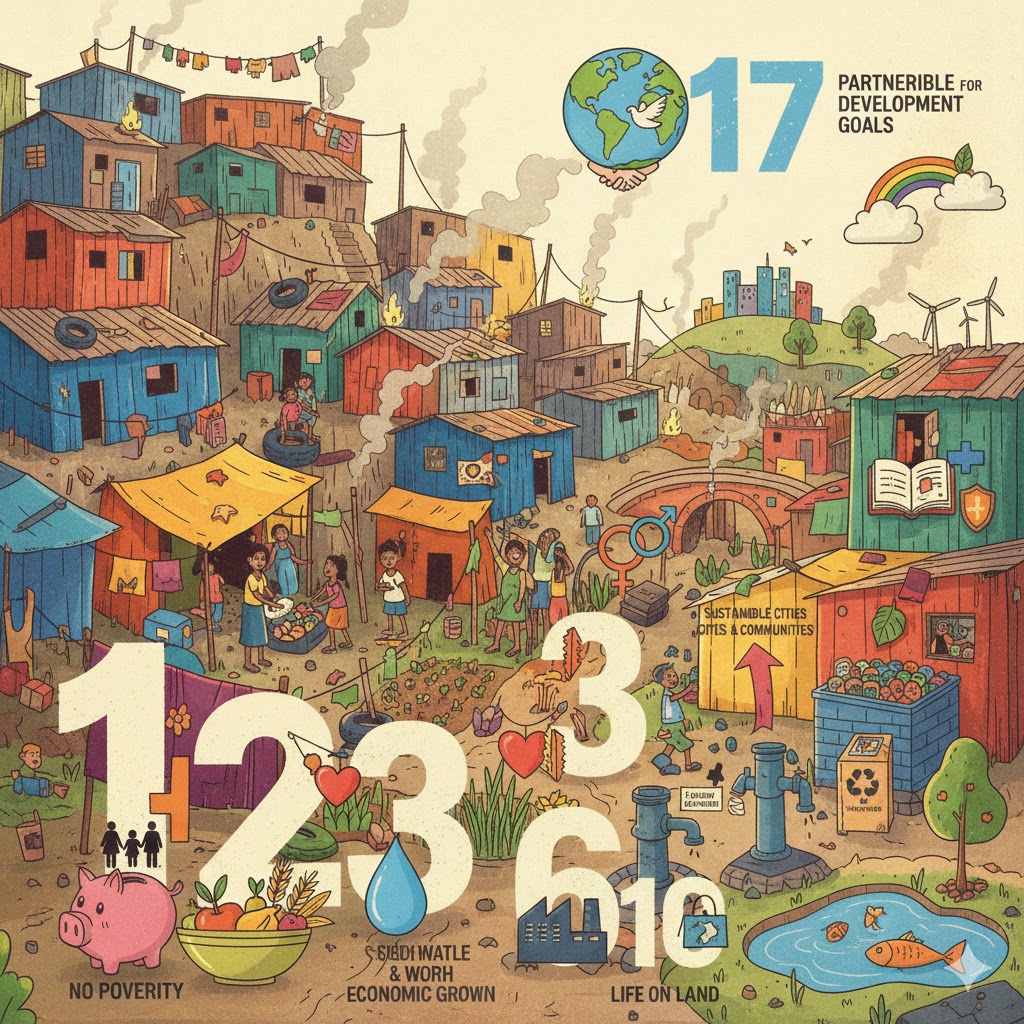
PELAKITA.ID – The Sustainable Development Goals (SDGs) represent the most ambitious and comprehensive global development framework ever adopted by the international community.
Formally launched in 2015 by the United Nations, the SDGs aim to address the world’s most pressing social, economic, and environmental challenges through a shared agenda for people, planet, and prosperity.
Historical Background
The roots of the SDGs can be traced back to earlier global development efforts, particularly the Millennium Development Goals (MDGs).
Adopted in 2000, the MDGs consisted of 8 goals focused primarily on poverty reduction, health, education, and gender equality, with a target deadline of 2015. While the MDGs succeeded in mobilizing global attention and resources—helping reduce extreme poverty and improve access to education and healthcare—they were also widely criticized for being too narrow, top-down, and primarily focused on developing countries.
Recognizing both the achievements and limitations of the MDGs, the international community sought a more inclusive, universal, and sustainable framework.
This effort was strongly influenced by the 1992 Earth Summit in Rio de Janeiro, the 2002 Johannesburg World Summit on Sustainable Development, and later the Rio+20 Conference in 2012, which emphasized the need to integrate economic growth, social inclusion, and environmental protection.
Following extensive global consultations involving governments, civil society, academia, the private sector, and millions of citizens worldwide, the SDGs were formally adopted on 25 September 2015 during the UN General Assembly in New York. The agenda was titled “Transforming Our World: the 2030 Agenda for Sustainable Development.”
Core Principles and Vision
At the heart of the SDGs is the principle of sustainability, defined as development that meets present needs without compromising the ability of future generations to meet their own. Unlike previous development frameworks, the SDGs are universal, meaning they apply to all countries, regardless of income level.
Another defining principle is “leaving no one behind.” This commitment emphasizes inclusion, equity, and the prioritization of the most vulnerable populations—such as women, children, indigenous peoples, persons with disabilities, and marginalized communities.
The SDGs also reflect a systems-based approach, recognizing that challenges such as poverty, inequality, climate change, and environmental degradation are interconnected and must be addressed holistically.
Scope and Structure of the SDGs
The SDG framework consists of 17 goals, 169 targets, and more than 230 global indicators. Together, they cover a broad spectrum of development dimensions:
-
No Poverty
-
Zero Hunger
-
Good Health and Well-being
-
Quality Education
-
Gender Equality
-
Clean Water and Sanitation
-
Affordable and Clean Energy
-
Decent Work and Economic Growth
-
Industry, Innovation, and Infrastructure
-
Reduced Inequalities
-
Sustainable Cities and Communities
-
Responsible Consumption and Production
-
Climate Action
-
Life Below Water
-
Life on Land
-
Peace, Justice, and Strong Institutions
-
Partnerships for the Goals
These goals span social development (health, education, equality), economic transformation (jobs, innovation, infrastructure), environmental protection (climate, oceans, biodiversity), and governance (institutions, justice, partnerships).
Importantly, SDG 17 underscores that achieving the agenda requires global cooperation, financing, technology transfer, capacity building, and multi-stakeholder partnerships involving governments, the private sector, academia, and civil society.
Implementation and Governance
The SDGs are not legally binding, but governments are expected to take ownership and integrate them into national development plans, policies, and budgets.
Progress is reviewed annually through the High-Level Political Forum (HLPF) at the UN, where countries present Voluntary National Reviews (VNRs) outlining achievements, challenges, and lessons learned.
Implementation relies heavily on data and monitoring, with national statistical offices playing a crucial role. However, many countries—especially low-income and fragile states—continue to face challenges related to data gaps, financing, and institutional capacity.
Current Status and Progress to Date
As of the mid-2020s, progress toward the SDGs has been uneven and fragile. While notable advances have been made in areas such as renewable energy adoption, digital connectivity, and access to education, many goals are off track.
The COVID-19 pandemic marked a major setback, reversing years of progress in poverty reduction, health, and education. Global extreme poverty increased for the first time in decades, learning losses widened educational inequalities, and health systems were severely strained.
Similarly, the escalating climate crisis has undermined progress on food security, water access, biodiversity conservation, and livelihoods—particularly in vulnerable regions such as small island states, coastal zones, and arid areas.
According to UN assessments, only a small fraction of SDG targets are currently on track to be achieved by 2030. Many indicators show stagnation or regression, especially those related to inequality, climate action, and environmental sustainability.
The Road Ahead
Despite these challenges, the SDGs remain a vital global compass. They have reshaped development discourse, influenced national policies, guided donor priorities, and provided a common language for sustainability across sectors.
The remaining years to 2030 require accelerated action, increased financing, stronger political commitment, innovation, and deeper collaboration. Equally important is the localization of the SDGs—ensuring that global goals translate into meaningful change at the community level.
Ultimately, the SDGs are not merely a checklist of targets, but a moral and political commitment to a fairer, more resilient, and sustainable world. Their success will depend not only on governments and institutions, but on collective action by societies worldwide.
References
United Nations. (2015).
Transforming Our World: The 2030 Agenda for Sustainable Development.
United Nations General Assembly Resolution A/RES/70/1. New York: United Nations.
United Nations. (2023).
The Sustainable Development Goals Report 2023.
New York: United Nations Department of Economic and Social Affairs (UN DESA).
United Nations Development Programme (UNDP). (2024).
What are the Sustainable Development Goals?
UNDP. https://www.undp.org/sustainable-development-goals
United Nations Department of Economic and Social Affairs (UN DESA). (n.d.).
Sustainable Development Goals Knowledge Platform.
https://sdgs.un.org
Sachs, J. D. (2015).
The Age of Sustainable Development.
New York: Columbia University Press.
Sachs, J. D., Schmidt-Traub, G., Kroll, C., Lafortune, G., & Fuller, G. (2023).
Sustainable Development Report 2023.
Cambridge: Cambridge University Press.
World Bank. (2022).
Poverty and Shared Prosperity 2022: Correcting Course.
Washington, DC: World Bank.
OECD. (2016).
Measuring Distance to the SDG Targets: An Assessment of Where OECD Countries Stand.
Paris: Organisation for Economic Co-operation and Development.
United Nations General Assembly. (2012).
The Future We Want.
Outcome document of the United Nations Conference on Sustainable Development (Rio+20).
United Nations Statistics Division. (2023).
Global Indicator Framework for the Sustainable Development Goals and Targets of the 2030 Agenda.
New York: United Nations.