
- In Southeast Asia, particularly in regions that are now Indonesia, Thailand, Vietnam, and southern China, early shrimp culture emerged through extensive, low-input systems.
- Coastal farmers constructed simple earthen ponds connected to estuaries and mangrove creeks. Juvenile shrimp entering naturally with tidal flows were retained and grown until harvest.
PELAKITA.ID – Shrimp aquaculture has become one of the most valuable and technologically advanced sectors in global food production.
Today, farmed shrimp dominate international seafood markets, supplying millions of tons annually and supporting livelihoods across Asia, Latin America, and beyond. Yet this modern industry has deep historical roots, evolving gradually from traditional water management practices into a complex, science-driven global enterprise.
Early Origins: Aquaculture Before Modern Technology
The origins of shrimp aquaculture are closely tied to the broader history of aquaculture itself, which dates back thousands of years. Archaeological and historical records suggest that aquaculture began in ancient China around 2000 BCE, primarily with carp culture.
While shrimp were not initially the main focus, coastal communities in Asia soon learned to take advantage of natural tidal systems to trap and grow aquatic organisms, including shrimp.
In Southeast Asia, particularly in regions that are now Indonesia, Thailand, Vietnam, and southern China, early shrimp culture emerged through extensive, low-input systems.
Coastal farmers constructed simple earthen ponds connected to estuaries and mangrove creeks. Juvenile shrimp entering naturally with tidal flows were retained and grown until harvest.
These systems relied almost entirely on natural productivity—sunlight, plankton, and detritus—without artificial feed or chemicals. Production levels were low, but environmental impacts were minimal, and farming was well integrated with local ecosystems.
Traditional Systems and the Role of Mangroves
For centuries, shrimp culture coexisted with mangrove forests, which provided nursery grounds, water filtration, and natural feed sources. In countries like Bangladesh and Indonesia, integrated mangrove–aquaculture systems developed, later known as silvofisheries.
These practices demonstrated an early understanding of ecological balance, even if not articulated in modern scientific terms.
However, these traditional systems were vulnerable to natural variability. Yields fluctuated with seasons, tides, and weather, and farmers had limited control over growth rates or survival.
The Turning Point: Scientific Discovery and Species Selection
The modern era of shrimp aquaculture began in the mid-20th century, driven by advances in marine biology and hatchery science. A major breakthrough occurred in the 1930s and 1940s, when Japanese scientists successfully induced shrimp maturation and larval development in controlled environments.
This laid the foundation for reliable hatchery production of shrimp seed, reducing dependence on wild post-larvae.
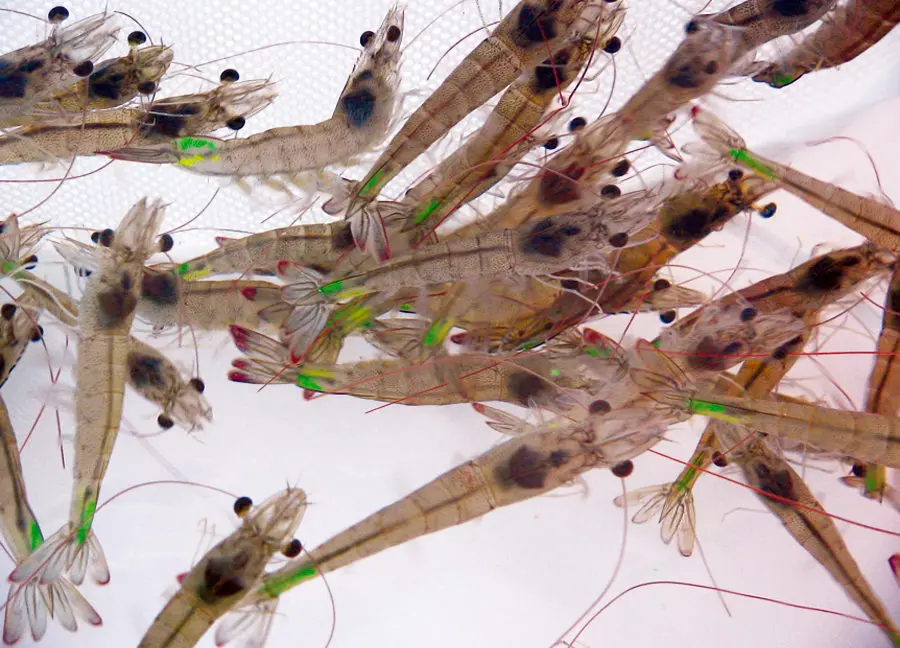
By the 1960s and 1970s, attention turned to identifying species suitable for farming. The black tiger shrimp (Penaeus monodon) emerged as a dominant species in Asia due to its large size and high market value.
In the Americas, the Pacific white shrimp (Litopenaeus vannamei) gained prominence for its fast growth and adaptability. These developments marked a critical shift: shrimp farming was no longer an opportunistic activity but a planned production system.
Intensification and the Technology Boom (1970s–1990s)
From the 1970s onward, shrimp aquaculture entered a phase of rapid intensification. Rising global demand—particularly from the United States, Japan, and Europe—turned shrimp into a lucrative export commodity. Governments and private investors poured resources into expanding production.
Key technological inputs transformed the industry:
-
Formulated feeds replaced natural productivity as the main growth driver, allowing higher stocking densities.
-
Mechanical aeration improved oxygen levels, enabling shrimp to survive in more crowded ponds.
-
Water exchange systems enhanced waste removal and growth rates.
-
Selective breeding and hatchery refinement improved survival and uniformity.
Production soared, but intensification came at a cost. Large areas of mangroves were cleared to make way for ponds, particularly in Southeast Asia and Latin America. Environmental degradation, social conflicts, and disease outbreaks became increasingly common.
Disease Crises and Industry Collapse
By the 1990s, the limits of unregulated intensification became clear. Viral diseases such as White Spot Syndrome Virus (WSSV) swept through Asia and later the Americas, causing massive crop failures and bankruptcies. Entire farming regions collapsed almost overnight.
These crises forced a reckoning. Farmers, scientists, and policymakers realized that technological inputs alone were insufficient without biosecurity, environmental management, and governance.
The Biosecure and Sustainable Turn (2000s)
The early 2000s marked a new chapter in shrimp aquaculture. The industry began adopting biosecurity-based production models:
-
Specific Pathogen-Free (SPF) broodstock reduced disease risks at the hatchery level.
-
Lined ponds and closed systems limited pathogen entry.
-
Better water quality management reduced stress and mortality.
-
Improved diagnostics and health monitoring enabled early intervention.
At the same time, Litopenaeus vannamei largely replaced black tiger shrimp as the dominant farmed species worldwide. Its tolerance to higher stocking densities, lower salinity, and formulated feeds made it ideal for controlled systems.
Technological Innovation and Digitalization
In the last decade, shrimp aquaculture has increasingly embraced advanced technology. Sensors now monitor oxygen, temperature, pH, and ammonia in real time. Automated feeders optimize feed efficiency and reduce waste. Genetic programs focus on disease resistance rather than just growth.
Biofloc technology, recirculating aquaculture systems (RAS), and zero-water-exchange models have gained traction, particularly in regions facing land and water constraints. These systems recycle nutrients, minimize environmental discharge, and increase productivity per unit area.
Digital platforms and artificial intelligence are now used to analyze pond data, predict disease risks, and support farm management decisions, marking a new era of precision aquaculture.
Social, Environmental, and Future Challenges
Despite technological progress, shrimp aquaculture continues to face challenges. Small-scale farmers often struggle to access capital and technology.
Climate change increases risks from temperature extremes, flooding, and salinity shifts. Environmental concerns remain, particularly regarding effluents, feed sustainability, and coastal land use.
In response, certification schemes, ecosystem-based management, and integrated multi-trophic aquaculture are gaining importance. The future of shrimp farming increasingly depends on balancing productivity with resilience, equity, and environmental stewardship.
Conclusion: An Evolving Industry
The story of shrimp aquaculture is one of continuous adaptation. From ancient tidal ponds to data-driven farms, it reflects humanity’s evolving relationship with aquatic ecosystems.
Technology has been both a catalyst for growth and a source of crisis, underscoring the need for thoughtful integration rather than unchecked expansion.
As global demand for seafood continues to rise, shrimp aquaculture stands at a crossroads. Its future will be shaped not only by innovation, but by how well it learns from its past—honoring ecological limits while feeding a growing world.
References
-
FAO (Food and Agriculture Organization of the United Nations).
The State of World Fisheries and Aquaculture (SOFIA).
FAO, Rome. (Edisi terbaru dan beberapa edisi sebelumnya).
— Referensi utama untuk data historis, produksi global, dan tren akuakultur udang. -
FAO Fisheries and Aquaculture Technical Paper No. 475.
Cultured Aquatic Species Information Programme: Penaeus monodon & Litopenaeus vannamei.
FAO, Rome.
— Menjelaskan sejarah domestikasi, biologi, dan perkembangan teknologi kedua spesies utama udang budidaya. -
Rosenberry, B. (ed.).
Shrimp News International – Annual Shrimp Farming Reviews.
Shrimp News International, USA.
— Sumber industri penting mengenai evolusi teknologi, penyakit, dan dinamika global budidaya udang. -
Naylor, R. L., et al. (2000).
Effect of aquaculture on world fish supplies.
Nature, 405, 1017–1024.
— Analisis awal dampak intensifikasi akuakultur, termasuk udang, terhadap lingkungan dan perikanan dunia. -
Boyd, C. E., & Tucker, C. S. (1998).
Pond Aquaculture Water Quality Management.
Springer, New York.
— Referensi klasik tentang manajemen kualitas air yang menjadi dasar intensifikasi tambak udang. -
Lightner, D. V. (1996).
A Handbook of Shrimp Pathology and Diagnostic Procedures for Diseases of Cultured Penaeid Shrimp.
World Aquaculture Society.
— Rujukan utama mengenai penyakit udang, termasuk White Spot Syndrome Virus (WSSV). -
Bostock, J., et al. (2010).
Aquaculture: global status and trends.
Philosophical Transactions of the Royal Society B, 365(1554), 2897–2912.
— Menjelaskan pergeseran dari sistem tradisional ke sistem intensif dan biosecure. -
Avnimelech, Y. (2015).
Biofloc Technology: A Practical Guide Book.
World Aquaculture Society.
— Referensi penting tentang teknologi biofloc dan sistem minim pergantian air. -
Primavera, J. H. (2006).
Overcoming the impacts of aquaculture on the coastal zone.
Ocean & Coastal Management, 49(9–10), 531–545.
— Membahas sejarah hubungan budidaya udang dengan mangrove dan ekosistem pesisir. -
World Bank (2014).
Reducing Disease Risk in Aquaculture.
World Bank Report.
— Analisis kebijakan dan ekonomi tentang krisis penyakit dan reformasi biosekuriti. -
Tacon, A. G. J., & Metian, M. (2015).
Feed matters: satisfying the feed demand of aquaculture.
Reviews in Fisheries Science & Aquaculture, 23(1), 1–10.