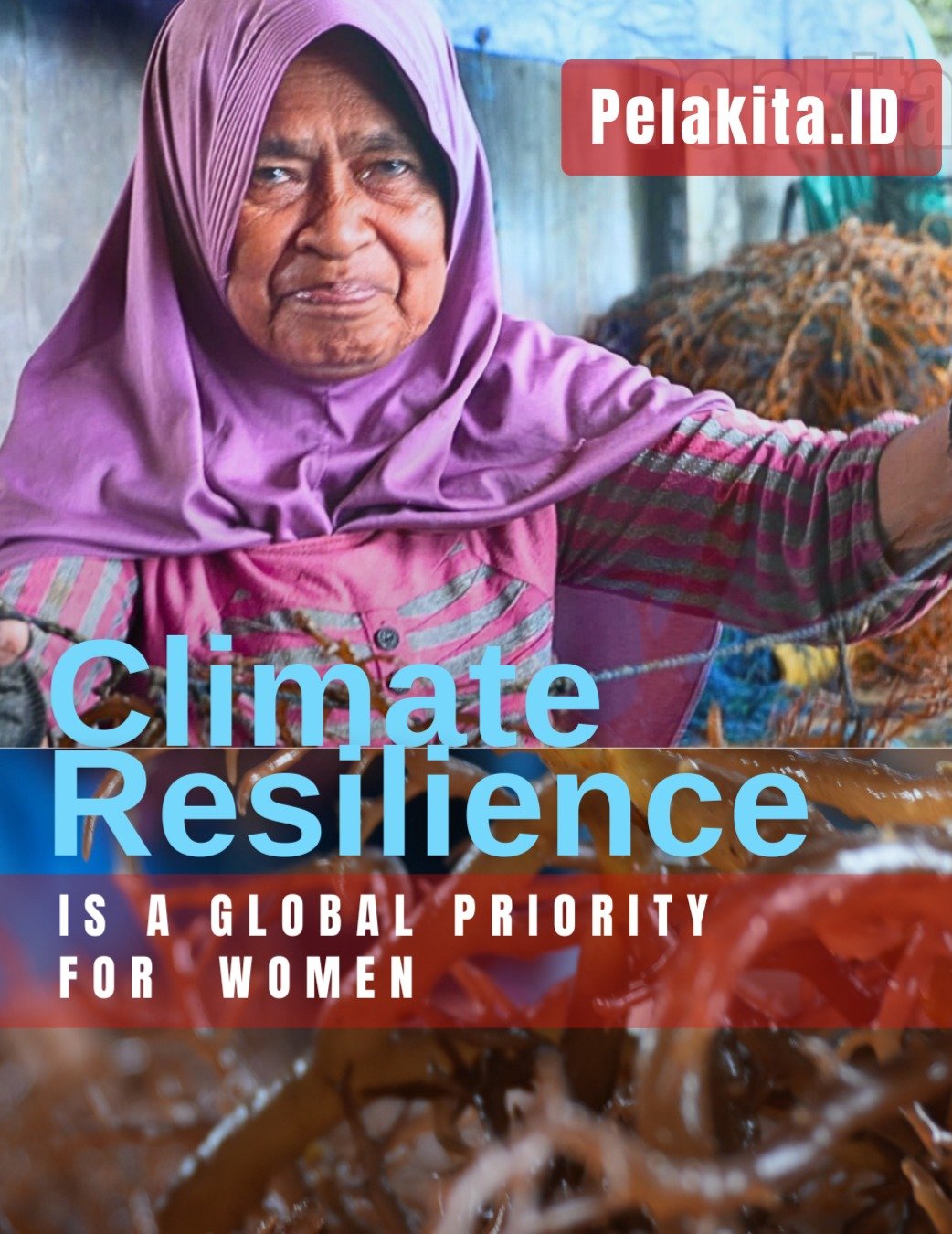


PELAKITA.ID – Climate change is no longer a distant environmental threat—it is already reshaping the oceans and the fisheries that millions of people depend on for food, livelihoods, and cultural identity.
Global research shows a consistent pattern: warming seas, changing currents, declining productivity, and shifting fish stocks are altering the volume and distribution of fisheries catch around the world. For many tropical and developing countries, the impacts are increasingly severe.
This article synthesizes key findings from major scientific bodies—including FAO, OECD, MSC, NOAA, Rutgers University, and the Sea Around Us Project—to present the strongest evidence of how climate change is transforming global fisheries.
Ocean Warming and Declining Catch Potential
One of the clearest indicators that climate change is affecting fisheries is the global rise in sea surface temperature.
According to NOAA, the world’s oceans have absorbed more than 90% of excess heat caused by greenhouse gas emissions, resulting in long-term warming trends and more frequent marine heatwaves.
These conditions alter the physiology, behavior, and survival of fish species—especially those sensitive to temperature changes.
A landmark study led by Rutgers University (Science, 2019) found that ocean warming has already reduced sustainable catch levels by 4.1% worldwide between 1930 and 2010. Some regions—particularly the North Sea and East China Sea—experienced losses between 15% and 35%.
The study also shows that stocks already stressed by overfishing are more vulnerable to climate pressures, emphasizing that climate change and poor management create a dangerous combination.
The Marine Stewardship Council (MSC) further reinforces this, noting that the frequency of marine heatwaves has increased by 50% over the past three decades, reducing habitat quality and lowering productivity for many commercial species.
Shifts in Species Distribution: Fish Are Moving North, South, or Deeper
Perhaps the most consistent finding across global fisheries research is that fish are moving. As waters warm, species migrate toward cooler latitudes or into deeper ocean layers where temperatures are more stable.
The Sea Around Us Project (Cheung et al., 2010) estimates that global fish stocks are moving at an average rate of 30–40 km per decade toward the poles.
Tropical regions—including Southeast Asia, the Indian Ocean, East Africa, and the Pacific Islands—are projected to lose up to 40% of potential catch by 2050, while some high-latitude regions may see increases.
FAO’s Common Oceans Program highlights this pattern in tuna fisheries: species like skipjack, yellowfin, and bigeye are shifting eastward and into cooler waters, challenging existing quota systems and international fisheries agreements. Without adaptation, uncertainties may increase conflict between nations that share migratory stocks.
This movement is not just theoretical—many fisheries are already experiencing it. For instance, new species appear in Japan, Alaska, and northern Europe, while tropical artisanal fishers report difficulty locating formerly abundant species that have moved farther offshore.
Impacts on Productivity and Marine Ecosystems
Climate change does not only change where fish live—it also affects the productivity of entire marine ecosystems.
Declining Primary Productivity
Warmer waters can reduce nutrient mixing, lowering plankton production. Because plankton form the base of the marine food web, reductions affect all higher-level species, including commercial fish. Declining chlorophyll-a levels—used as indicators of productivity—have been recorded in many tropical regions.
Habitat Loss
Critical fish habitats are also deteriorating:
-
Mangroves suffer from sea-level rise and coastal erosion.
-
Coral reefs are experiencing bleaching events that reduce habitat complexity and juvenile fish survival.
-
Seagrass beds decline due to heat stress and changing sedimentation.
The Ocean Conservancy (2021) reports that without significant global mitigation, these ecosystem changes could reduce global catch potential by up to 25% by 2100.
Economic Consequences for Fisheries and Communities
Climate-driven declines in fish stocks have direct economic consequences. The OECD’s report “Sustainable Fisheries Management in a Changing Climate” (2025) warns that by the end of the century, global fisheries revenues could fall by up to 24%, with the largest losses occurring in tropical countries where dependence on small-scale fisheries is high.
For small island states and coastal communities in Asia, Africa, and the Pacific:
-
Fewer fishing days occur due to storms, high waves, or shifting seasons.
-
Fuel consumption increases as fish move farther offshore.
-
Increased competition for dwindling stocks can lead to conflict and unsustainable practices.
These pressures compound existing vulnerabilities, making adaptation essential.
Evidence From Specific Regions
Asia
Southeast Asia—home to some of the world’s most productive fisheries—is among the regions most threatened by climate change. Increasing temperatures, coral bleaching, monsoon variability, and extreme events are changing fish abundance and migration. FAO reports declines in catch stability for small pelagic fish, which form the backbone of artisanal fisheries.
Pacific Islands
Many Pacific Island nations rely on tuna for economic revenue. As tuna migrate eastward or into deeper waters, the distribution of catch shifts toward nations with larger EEZs, creating economic inequalities.
Europe and North America
Northern waters show increases in some commercial stocks due to warming, though ecosystem disruptions and invasive species complicate the picture. For example, mackerel shifts between Iceland, Greenland, and EU waters sparked diplomatic disputes.
Are There Successful Adaptations?
The good news: adaptation works.
Some regions have successfully incorporated climate science into fisheries management. For example:
-
Wakatobi (Indonesia) uses oceanographic information to guide fishing seasons and protect key habitats.
-
Norway and Iceland monitor species distribution in real time and adjust quotas accordingly.
-
Pacific Island nations collaborate on tuna management through the Parties to the Nauru Agreement (PNA), increasing their bargaining power.
Where communities have access to accurate weather forecasts, early-warning systems, and ecosystem-based management, productivity becomes more stable despite climate pressures.
What the Science Concludes
Across all these studies, the scientific consensus is clear:
-
Climate change is already reducing global fisheries productivity.
-
The tropics—and the world’s poorest fishing communities—are hit the hardest.
-
Fish are moving to cooler waters, disrupting traditional fishing grounds.
-
Combined with overfishing and habitat loss, climate change creates severe long-term risks.
-
Adaptation is possible but requires better data, strong governance, and resilient ecosystems.
The world’s fisheries are at a critical juncture. With decisive action—integrating climate science into fisheries management, restoring ecosystems, and empowering fishing communities—there is still an opportunity to safeguard global seafood systems for generations to come.
___
References
1. IPCC (Intergovernmental Panel on Climate Change)
IPCC AR6 Working Group II (2022). Impacts, Adaptation, and Vulnerability.
The chapters on Oceans and Fisheries emphasize that ocean warming, declining oxygen levels, and shifts in fish stocks have significant impacts on global fisheries production.
IPCC Special Report on the Ocean and Cryosphere in a Changing Climate — SROCC (2019).
Provides strong evidence that the global maximum sustainable yield (MSY) is declining due to ocean warming.
2. FAO (Food and Agriculture Organization)
FAO (2022). The State of World Fisheries and Aquaculture (SOFIA).
Presents data on declining fisheries productivity in various marine regions as a result of climate change and ocean acidification.
FAO (2018). Impacts of Climate Change on Fisheries and Aquaculture.
A global technical report detailing fish stock shifts, risks to small-scale fishers, and adaptation responses.
3. Peer-reviewed Journal Articles (Leading International Research)
Shifts in Fish Distribution & Productivity
Cheung, W.W.L. et al. (2010). “Large-scale redistribution of maximum fisheries catch potential in the global ocean under climate change.” Global Change Biology.
One of the most cited studies; shows that maximum catch potential may drop by up to 40% in tropical regions.
Cheung, W.W.L. & Pauly, D. (2016). “Impacts and effects of ocean warming on marine fishes.” ICES Journal of Marine Science.
Explains scientific evidence that fish are moving into cooler and deeper waters.
Ocean Warming & Oxygen Decline
Pörtner, H.O. et al. (2021). “Climate Change 2021: The Physical Science Basis.” IPCC WG I.
Confirms that oceans are becoming warmer and less oxygenated—two major factors reducing fish biomass.
Deutsch, C. et al. (2015). “Climate change tightens a metabolic constraint on marine habitats.” Science.
Shows that ocean warming restricts habitable marine areas, triggering fish migration.
Impacts on Small-Scale Fishing Communities
Allison, E.H. et al. (2009). “Vulnerability of national economies to the impacts of climate change on fisheries.” Fish and Fisheries.
Reveals that tropical nations, including Indonesia, are among the most vulnerable due to their dependence on small-scale fisheries.
Cinner, J. et al. (2018). “Building adaptive capacity to climate change in tropical coastal communities.” Nature Climate Change.
Explains proven adaptation mechanisms for small-scale fishers.
Ocean Productivity & Declining Catches
Free, C.M. et al. (2019). “Impacts of historical warming on marine fisheries production.” Science.
Finds that global warming has caused a 4.1% decline in global fisheries production since 1930.
Bindoff, N.L. et al. (2019). SROCC: Changing Ocean, Marine Ecosystems, and Dependent Communities.
Confirms long-term trends of declining fish catches in many tropical marine regions.