
Indonesia’s journey as a maritime power has reached a turning point. The path forward is no longer a straight line toward increased extraction; it is a complex navigation through the intersections of sustainability, resilience, and equity.
PELAKITA.ID – As the world’s largest archipelagic nation, Indonesia is more than a geographic marvel; it is a major maritime power in the Indo-Pacific. Its vast waters support millions of livelihoods and provide strategic food resources that are vital to regional stability.
Yet, this immense potential has brought the nation to a critical crossroads.
The paradox is clear: while the sea is Indonesia’s greatest asset, it is also the site of its most complex challenges.
Marine and fisheries policy has transcended the simple goal of increasing production. It is no longer just about the volume of the catch; it is a high-stakes web where climate change, social inequality, and geopolitical competition collide.
To navigate this, the government must move beyond traditional extraction and confront several hard truths about its maritime future.
Takeaway 1: The “Everything” Policy – Why Fisheries Are No Longer Just About Fish
In the modern era, fisheries management is an “everything” policy. The sector no longer exists in a vacuum. Instead, it intersects with food security, energy politics, and international trade. This complexity demands a shift toward an adaptive and inclusive approach that prioritizes long-term resilience over short-term export boosts.
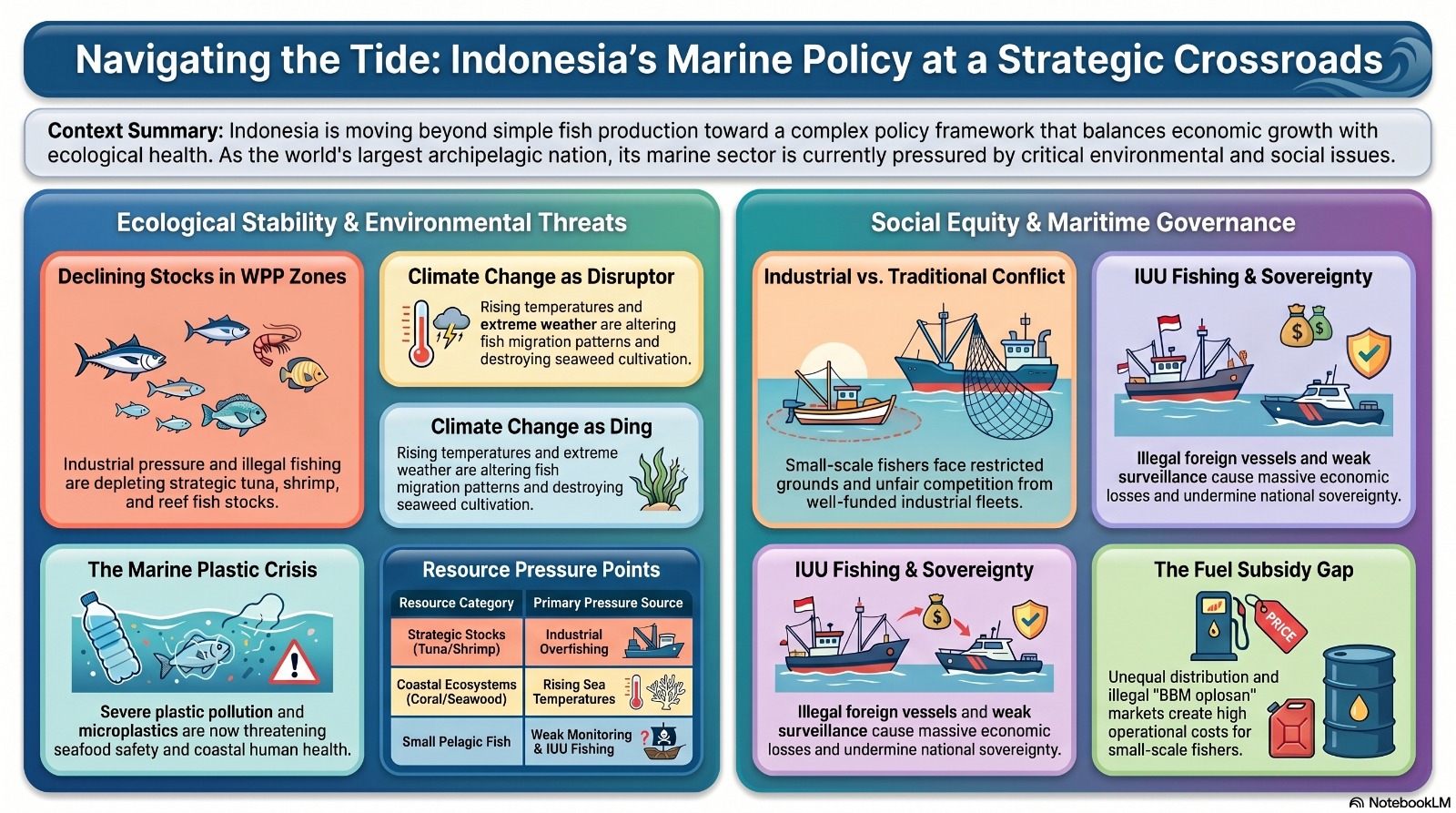
The stakes are particularly high in Indonesia’s Fisheries Management Areas (WPP). Strategic species such as tuna, shrimp, reef fish, and small pelagic fish are under mounting pressure.
This isn’t just an environmental concern; it is a matter of national stability. When stocks decline due to rising domestic and international demand, the ripple effects are felt across the entire Indo-Pacific, forcing a re-evaluation of how a maritime giant balances economic growth with ecological limits.
Takeaway 2: Climate Change is an Everyday Reality, Not a Future Threat
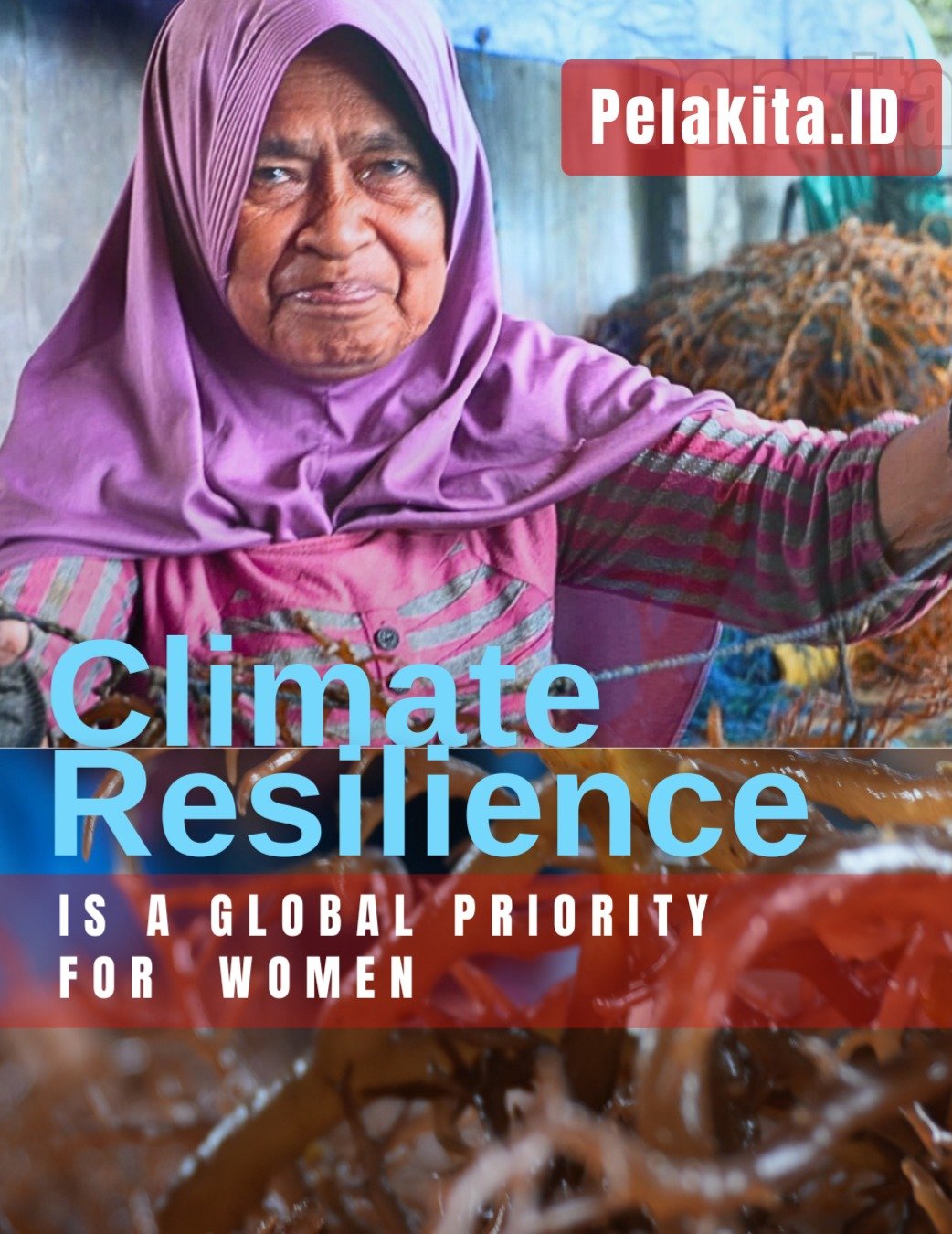
While global policy debates often treat climate change as a looming milestone, for Indonesia’s coastal communities, the crisis is a lived experience. Rising sea temperatures and coastal erosion are actively altering fish migration patterns and devastating seaweed cultivation.
“For many coastal villages, climate change is no longer a future threat but an everyday reality.”
For these communities, climate adaptation is not a theoretical white paper—it is a struggle for survival against sea-level rise and increasingly extreme weather events.
The health of coral reefs, which serve as the nurseries for the nation’s fisheries, is declining, leaving small-scale fishers with fewer resources and greater uncertainty.
Takeaway 3: The “BBM Oplosan” Crisis and the Fuel Access Gap
Fuel is the single largest operational cost in capture fisheries, making subsidized fuel a literal lifeline for small-scale fishers. However, a deep rift exists between national policy and local reality.
This gap has fueled the rise of “BBM oplosan”—illegal mixed fuels—which creates dangerous tensions between fishers and regulators.
This crisis is driven by three persistent factors:
Unending Poverty: Small-scale fishers lack the capital to survive without subsidies or to absorb price spikes.
Operational Costs: The high cost of fuel makes fishing economically unviable for those without industrial backing.
Distribution Bottlenecks: Despite government allocations, many remote coastal communities cannot efficiently access the fuel they are promised.
This isn’t just a logistics problem; it is a symptom of social inequality that leaves the most vulnerable fishers at the mercy of informal and often illegal markets.
Takeaway 4: The David vs. Goliath Battle and the IUU Threat
Tensions between industrial fishing fleets and traditional fishers are becoming increasingly visible. As industrial activities expand, local communities find themselves squeezed out of ancestral fishing grounds, facing declining catches and unfair competition.
“Many small-scale fishers argue that industrial fleets enjoy disproportionate access to marine resources, while coastal communities face restricted fishing grounds, declining catches, and unfair competition.”
Compounding this internal struggle is the persistent threat of Illegal, Unreported, and Unregulated (IUU) fishing.
Illegal foreign vessels and destructive fishing methods not only damage ecosystems but also undermine Indonesia’s maritime sovereignty. The battle for the sea is a two-front war: protecting local fishers from industrial overreach while defending national borders against resource theft.
Takeaway 5: The Blue Economy Trap – Avoiding Land-Based Mistakes
The government is aggressively promoting a “Blue Economy” agenda, focusing on aquaculture expansion, downstreaming, and even carbon trading.
While these initiatives offer economic hope, there is a legitimate fear that they may fall into an “extractive trap”—repeating the same mistakes made in land-based mining and forestry.
“Critics warn that rapid marine-based development without strong ecological safeguards may repeat the extractive patterns often associated with land-based industries.”
To succeed, the government must ensure that fisheries downstreaming and modernized cold-chain logistics don’t just benefit large corporations.
Without strong ecological safeguards and protection against the marginalization of local communities, the Blue Economy risks becoming another engine of inequality rather than a sustainable path forward.
Takeaway 6: Plastic is the New Public Health Crisis
The narrative of Indonesian fisheries is being rewritten by plastic. Indonesia remains one of the nations most affected by marine plastic pollution, a crisis that directly impacts tourism areas, coral reefs, and seafood safety.
“The increasing presence of microplastics in seafood has also raised concerns about long-term human health impacts.”
This reality forces marine policy to integrate with broader environmental governance and circular economy initiatives. If the seafood that feeds the nation is contaminated, the fisheries sector shifts from an economic asset to a public health liability. Protecting the ocean now requires managing waste systems on land as strictly as fishing quotas at sea.
Conclusion: The Future of a Maritime Giant
Indonesia’s journey as a maritime power has reached a turning point. The path forward is no longer a straight line toward increased extraction; it is a complex navigation through the intersections of sustainability, resilience, and equity.
The nation must decide if its maritime legacy will be defined by how much wealth it can rapidly harvest, or by its ability to preserve a thriving ecosystem. Will Indonesia choose the path of short-term exploitation, or will it lead the way in building a truly responsible and inclusive maritime future?