
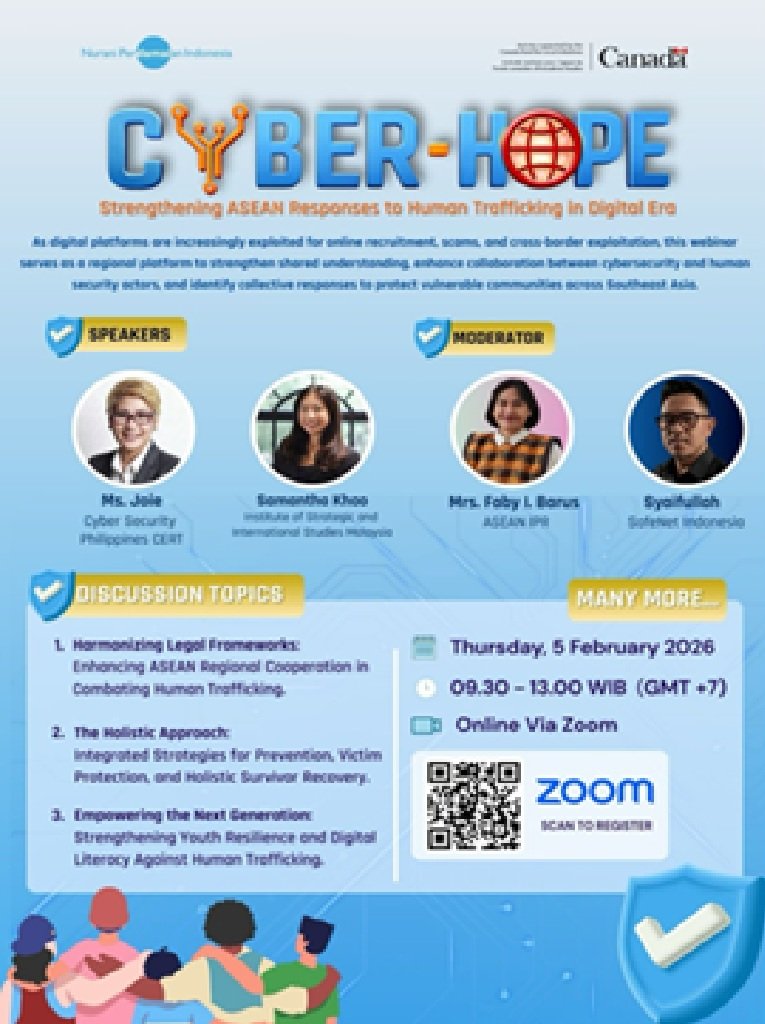
PELAKITA.ID — The webinar CYBER-HOPE: Strengthening ASEAN Responses to Human Trafficking in the Digital Era, organized by Nurani Perdamaian Indonesia with support from the Canada Fund for Local Initiatives, was held on Thursday, 5 February 2026.
The discussion highlighted the increasing vulnerability of young people to digital crimes, particularly human trafficking amid the rapid development of information technology.
The webinar was structured around three main themes: Harmonizing Legal Frameworks: Enhancing ASEAN Regional Cooperation in Combating Human Trafficking, The Holistic Approach: Integrated Strategies for Prevention, Victim Protection, and Holistic Survivor Recovery, and Empowering Youth Resilience and Digital Literacy Against Human Trafficking.
As the discussions were conducted simultaneously in three virtual rooms via Zoom, the author attended the third session, Empowering Youth Resilience and Digital Literacy Against Human Trafficking.
This session featured speakers from ASEAN countries, including Ms. Joie, a representative from Cyber Security Philippines (CERT), and Samantha Khoo, a researcher from the Institute of Strategic and International Studies (ISIS) Malaysia. The discussion was moderated by Syaifullah from SafeNet Indonesia.
The session ran interactively from 09:30 a.m. to 1:00 p.m. (WITA). The materials presented were considered highly relevant to the Indonesian context, particularly due to similarities in social and cultural backgrounds with the speakers’ home countries.
In her presentation, Ms. Joie shared data indicating a significant increase in cybercrime in the Philippines. One of the main contributing factors is recruitment strategies that deliberately target vulnerable groups, including children and persons with disabilities.
Offers of entertainment, gifts, and money make these groups especially susceptible. Online gaming platforms, dating applications, and job-search apps have increasingly become new channels exploited for digital human trafficking.
Meanwhile, Samantha Khoo from ISIS Malaysia explained similar conditions in her country and outlined various prevention approaches. She emphasized the importance of involving young people, noting that approximately 70 percent of Malaysia’s population is under the age of 40 and highly dependent on social media.
“It is very important to involve young people in combating human trafficking because they are better equipped to recognize issues related to digital security,” Samantha stated.
Young people play a strategic role in preventing digitally facilitated human trafficking.
In addition to being the group most vulnerable to targeting, community-based approaches and youth networks are considered more effective in building awareness and strengthening digital resilience.
At the regional level, the main challenge in combating digital human trafficking lies in building strong relationships, networks, and cross-border cooperation among ASEAN countries. These efforts must actively involve civil society to ensure sustainable collaboration in collectively addressing this humanitarian crime.
The concerns that have long been felt must now be translated into action—not merely remaining at the level of awareness, but manifested through concrete efforts in education and public awareness.
This is essential to ensure that children and young people do not fall victim to crimes that are invisible yet have permeated nearly every aspect of modern life.
Author: Mamie