
His commitment to understanding coastal urban dynamics and sustainable spatial development later brought him to the United States, where he earned his Ph.D. in Planning from Virginia Commonwealth University, graduating on October 18, 1997, with a dissertation titled Spatial Characteristic of Waterfront City: Case of Ujung Pandang, Indonesia.
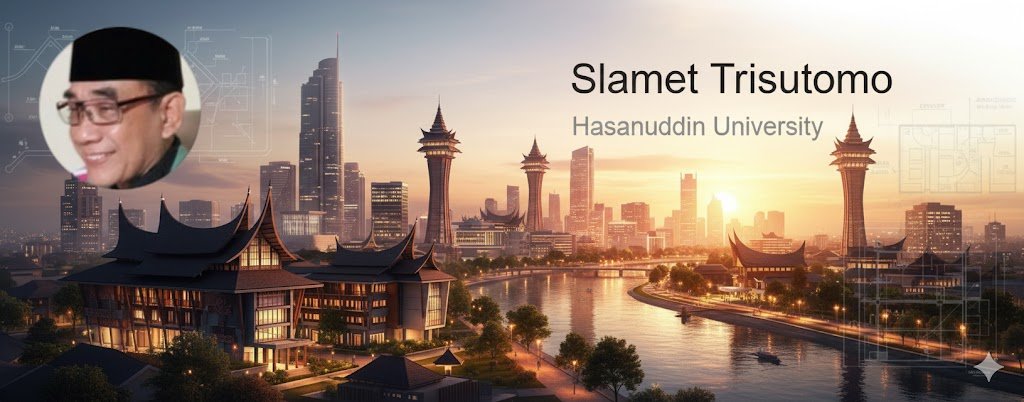
PELAKITA.ID – Prof. Dr. Ir. Slamet Tri Sutomo, MS stands among the senior scholars who have shaped the intellectual foundation of the Faculty of Engineering at Universitas Hasanuddin (Unhas).
Though he is not a public-facing academic with a large digital footprint, his presence has been deeply felt in classrooms, thesis defenses, curriculum development, and the long arc of Unhas’ growth as a major engineering institution in Indonesia.
His career represents a generation of educators whose contributions are best measured not by headlines, but by the thousands of graduates and ideas they helped nurture.
Prof. Tri Sutomo’s academic journey began with a strong grounding in engineering. Earning his Ir. degree provided him with a rigorous foundation in technical principles—likely within civil engineering, architecture, or spatial planning, fields closely aligned with his later academic roles.
He continued to deepen his expertise through a Master of Science (MS), a degree that strengthened his analytical and research skills. His pursuit of a doctoral degree (Ph.D.) crowned his academic formation, enabling him to contribute at the highest levels of scholarship, research supervision, and academic leadership.
This combination of engineering, planning, and environmental insight positioned him uniquely within Unhas.
As the university expanded its postgraduate offerings in the late 20th and early 21st centuries—including the Master’s and Doctoral Programs in Architecture, Urban and Regional Planning, Development Studies, and other applied social-technical fields—Prof. Tri Sutomo became one of the scholars entrusted to build academic quality from within.
He also serves as a lecturer in the Doctoral Program in Development Studies (S3 Pembangunan), teaching Research Methodology, a role that underscores his expertise in guiding advanced scholars through the design and execution of rigorous research.
His presence in this program highlights the interdisciplinary range he brings, bridging engineering knowledge with social science approaches to development.
Throughout his career, he has played multiple roles across the academic ecosystem. Within Unhas, he has been a lecturer for both undergraduate and postgraduate levels, a mentor for research students, and a guardian of academic standards.
His name frequently appears in faculty directories, doctoral committees, and academic event documentation. Students and junior colleagues often describe him as firm, knowledgeable, and deeply committed to the intellectual maturity of his learners.
Beyond the university, Prof. Tri Sutomo has contributed as an external examiner for doctoral defenses at major Indonesian universities, including Diponegoro University (UNDIP).
This role is reserved for scholars who are trusted to evaluate the quality of advanced research with fairness, expertise, and academic integrity. His presence as an examiner demonstrates national recognition—proof that his expertise is valued not only at Unhas, but within Indonesia’s broader academic community.
Prof. Tri Sutomo’s academic interests lie at the intersection of architecture, planning, environment, and regional development.
He is a senior academic at Universitas Hasanuddin with a strong and consistent educational foundation in urban planning, architecture, and environmental management.
He completed his Bachelor’s degree in Architecture at Universitas Gadjah Mada, graduating on December 5, 1975, with a thesis titled Studio Radio Nusantara RI II Yogyakarta. His deep interest in urban environmental issues led him to pursue a Master’s degree in Environmental Management at Universitas Hasanuddin, which he completed in 1989 with a thesis examining the influence of landscape and building density on the air temperature of Makassar City.
His commitment to understanding coastal urban dynamics and sustainable spatial development later brought him to the United States, where he earned his Ph.D. in Planning from Virginia Commonwealth University, graduating on October 18, 1997, with a dissertation titled Spatial Characteristic of Waterfront City: Case of Ujung Pandang, Indonesia.
This academic journey shaped the foundation of his expertise as one of Indonesia’s leading scholars in urban and environmental planning, forming the basis of his contributions to teaching, research, and methodological development at Universitas Hasanuddin.
His long involvement in the Doctoral Program in Architecture, the Master’s Program in Regional and Urban Planning, and the Doctoral Program in Development Studies reflects his understanding of how built environments, infrastructure, and social systems influence one another.
Although much of his work exists in academic reports, students’ theses, and institutional documents rather than public journals, his intellectual influence is evident in how Unhas’ engineering and planning programs have evolved over time.
One of his most significant legacies is mentorship. Over decades of teaching and supervision, he has guided countless undergraduate, master’s, and doctoral students—many of whom now hold key positions in government, industry, academia, and regional development planning. Through their work, his influence extends far beyond campus boundaries.
His students have become planners designing new city zones, engineers improving infrastructure in rural areas, academics shaping future knowledge, and consultants supporting national development programs. This generational impact may be the most enduring contribution of his career.
Institutionally, Prof. Tri Sutomo helped strengthen Unhas’ postgraduate landscape at a critical time.
The expansion of S2 and S3 programs required professors who were not only academically qualified but also committed to maintaining quality, developing curriculum, and building scholarly culture.
His involvement ensured that Unhas produced graduates with solid knowledge and professional competence—supporting the university’s ambition to become a research and innovation hub for Eastern Indonesia.
Although not a figure who frequently appears in the media, his legacy is woven into the quiet structures of academic life: in syllabi shaped by his ideas, in theses reviewed under his guidance, and in the institutional memory of the faculty he helped build. His is a legacy of consistency, service, and intellectual stewardship.
In essence, Prof. Dr. Ir. Slamet Tri Sutomo, MS represents a generation of Indonesian scholars whose dedication strengthened higher education from the inside.
His work may not always be written in glossy reports or international publications, but it continues to live in the students he mentored, the programs he developed, and the academic standards he upheld. Unhas stands stronger today because of scholars like him—quiet architects of progress whose contributions form the backbone of the university’s excellence.
Written by K. Azis
✅ Key References
-
In the Doctor of Architecture Program faculty list at Universitas Hasanuddin, Slamet Tri Sutomo, M.S. is listed among the doctoral faculty members. Unhas English+1
-
A publicly shared PDF of “Data Dosen” (faculty data) for Unhas includes his records: showing his S1, S2, S3 (though older document formatting) and his functional rank. Scribd+1
-
As of 2017, Prof. Slamet Tri Sutomo, MS was publicly active in academic accreditation: he acted as BAN-PT assessor visiting the Master Architecture Program at Universitas Udayana. unud.ac.id
-
He is listed as a member of the Waterfront City Planning and Development Laboratory under the Department of Urban and Regional Planning (PWK) at Unhas. Unhas English
-
The Journal of Regional and Maritime City Studies (Wilayah & Kota Maritim), a journal associated with Unhas PWK, lists him as part of the editorial board. COT UNHAS+1
-
A publication titled Spatial Structure of Waterfront Cities is attributed to “Slamet Trisutomo (1997)” in the context of waterfront city planning.