


- His commitment to development issues led him to continue his Master’s studies in Community Development at the University of the Philippines Los Baños, one of Asia’s leading centers for development studies.
- At the doctoral level, he deepened his expertise in Agricultural Extension at Cornell University, United States, which broadened his perspective on extension, innovation, and the transformation of agricultural systems.
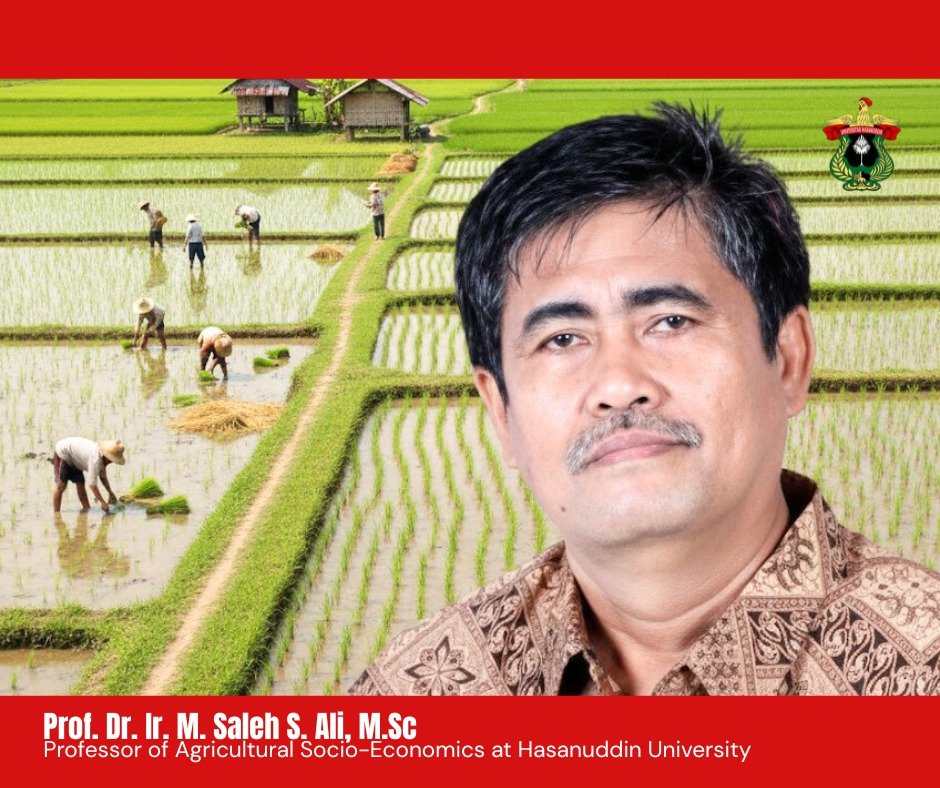
PELAKITA.ID – Prof. Dr. Ir. Muhammad Saleh S. Ali, M.Sc., is one of the most influential figures in the advancement of agricultural sciences and development studies at Hasanuddin University (Unhas).
Within the academic community, he is widely recognized as a scholar who consistently bridges agronomy and rural sociology with contemporary development approaches.
As a senior professor with decades of experience, he has played a major role in shaping the direction of education, research, and institutional capacity building at Unhas, particularly in the fields of agriculture and development.
His academic journey reflects a strong and multilayered foundation of knowledge. Starting from the discipline of agricultural sciences, he expanded his expertise into the social and policy realms.
M. Saleh Ali pursued a strong and consistent academic journey in the fields of agricultural development and community empowerment. He completed his Bachelor’s degree in Agricultural Socio-Economics at Hasanuddin University, a foundation that shaped his interest in the socio-economic dynamics of the agrarian sector.
His commitment to development issues led him to continue his Master’s studies in Community Development at the University of the Philippines Los Baños, one of Asia’s leading centers for development studies.
At the doctoral level, he deepened his expertise in Agricultural Extension at Cornell University, United States, which broadened his perspective on extension, innovation, and the transformation of agricultural systems.
The combination of education from these three institutions has built a solid academic framework and strengthened his contributions as an academic and a driving force in agricultural development studies in Indonesia.
This interdisciplinary orientation is evident in his research and publications, which cover a wide range of issues such as agrarian systems, institutional structures, farmers’ behavior, and socio-economic dynamics in rural areas. For Prof. Saleh, agriculture is a living system governed not only by technology but also by social, economic, and political interactions.
As an educator, Prof. Saleh plays a central role across various levels of academic training. He is an active lecturer in the Doctoral Program, particularly in the Development Studies concentration.
In this program, he teaches several core courses that form the intellectual framework for doctoral candidates: Philosophy of Science, Development Paradigms, and Political Ecology of Development.
These courses serve as crucial foundations for students to understand how knowledge evolves, how development theories shift across historical periods, and how power relations, ecology, and economic structures intertwine in development processes.
In his Philosophy of Science course, he invites students to explore the roots of knowledge: how scientific inquiry is constructed, what legitimizes a theory, and how paradigms shape one’s worldview.
In Development Paradigms, he provides a critical space for analyzing various schools of development thought—from modernization to post-development—and their relevance to the Indonesian context.
Through Political Ecology of Development, he emphasizes that development is never politically neutral. Power relations, control over resources, and environmental dynamics are central to understanding both the successes and failures of development initiatives.
His influence as an educator extends far beyond the classroom. Prof. Saleh has served as a promoter, co-promoter, and examiner for numerous doctoral dissertations.
His long academic experience makes him a highly respected mentor, renowned for his ability to guide students in uncovering theoretical depth while ensuring practical relevance in their research. Many of his students have gone on to become academics, researchers, government officials, and development practitioners who continue to build upon the intellectual foundations established under his mentorship.
Prof. Saleh’s contributions to the development of agricultural studies at Unhas can be seen in three main areas. First, he consistently strengthens interdisciplinary approaches by integrating social sciences into agricultural research.
He highlights that agricultural problems are not solely technical—related to seeds, fertilizers, or technology—but are also rooted in institutional arrangements, behavior, access, and social relations. This perspective helps expand the analytical lens of students and young researchers in understanding agrarian complexities in Indonesia.
Second, he actively promotes applied research that meets the needs of communities and local governments.
Many of the studies he supervises address real-world issues such as the sustainability of local agribusiness, farmers’ adaptation to climate change, institutional innovation, and plant–livestock production systems grounded in local wisdom. Through this, his contributions not only advance academic knowledge but also support regional development in tangible ways.
Third, his role in strengthening institutional quality is highly significant. His involvement in ensuring academic standards—through teaching, supervision, and evaluation—has helped solidify Unhas’ reputation as a key center for agricultural and development studies in Eastern Indonesia.
He has been instrumental in shaping a new generation of scholars who are intellectually rigorous, critical, and responsive to socio-ecological challenges.
The intellectual legacy of Prof. Muhammad Saleh S. Ali remains deeply felt today.
His dedication to cultivating critical and holistic perspectives on development has made him a pivotal figure in the evolution of scholarly thought at Unhas.
His insights into the interconnectedness of humans, the environment, and development remain highly relevant amid the increasingly complex challenges of modern agriculture.
Through his extensive contributions in teaching, research, and academic leadership, Prof. Saleh has become an essential pillar in building a more human-centered, sustainable, and socially rooted foundation for agricultural sciences.
His role as a lecturer in the Doctoral Program in Development Studies, along with his expertise in Philosophy of Science, Development Paradigms, and the Political Ecology of Development, firmly positions him as one of the key academic figures at Hasanuddin University.
___
Written by K. Azis
References
-
Unhas Postgraduate School (S3 Development Studies)
-
The Sekolah Pascasarjana website of Unhas lists Prof. Dr. Ir. Muhammad Saleh S. Ali, M.Sc. as the Head of the Doctoral Program in Development Studies.
-
That page also shows the structured curriculum: it includes courses such as Philosophy and Theory of Development (“Filsafat dan Teori Pembangunan”) and Philosophy of Science & Research Methods.
-
-
Unhas S3 Agricultural Science
-
The Unhas postgraduate site for the S3 Ilmu Pertanian (Doctoral Agricultural Studies) lists Prof. Saleh Ali among the faculty
-
-
Dosen List – Agribusiness / Socio-Economic Agriculture
-
On a WordPress page for the Agribusiness / Socio-Economic Agriculture Department of Unhas, he is listed as “Prof. Dr. Ir. M. Saleh S. Ali, M.Sc.”, with his specialization in Sosiologi Pertanian.
-
The Renstra (strategic plan) Pertanian Unhas 2020–2024 also includes his name, confirming his role in the social-economics / sociology of agriculture.
-
-
SINTA Profile
-
His SINTA (Indonesia’s academic database) profile lists him under Agriculture Sociology and Rural and Agricultural Development.
-
His SINTA ID is 6017133.
-
-
Research and Publication
-
His research contributions are documented on ResearchGate. For example: Analysis of Swiftlet House Agribusiness Sustainability … lists him as a co-author
-
Another ResearchGate profile also shows 44 research works.
-
-
Teaching of Political Ecology of Development
-
According to Unhas’s course information system (Moodle/Sikola), there is a course called “Politik Ekologi Pembangunan” (Political Ecology of Development) for S3, and Prof. Muhammad Saleh S. Ali, M.Sc. is listed as a lecturer in that course.
-
In a doctoral dissertation (Jumiati, 2018) on irrigation management using a political ecology perspective, Prof. M. Saleh S. Ali is listed as promotor.
-
-
Academic Background / Profile
-
In a publication (“Ringkasan Kumpulan Mazhab Teori Sosial”), there is an author profile that mentions M. Saleh Ali as Guru Besar (Professor) in Sosiologi & Filsafat, his MSc, and his PhD from Cornell University
-
In the Asian Rural Sociology VI Program Book, an abstract shows “M. Saleh S. Ali, PhD, Hasanuddin University” with discussion about local vs modern knowledge in rice farming.
-
-
Recent Academic Role
-
According to a campus news site, Prof. Saleh acted as a promotor in a doctoral dissertation defense in 2025.
-