
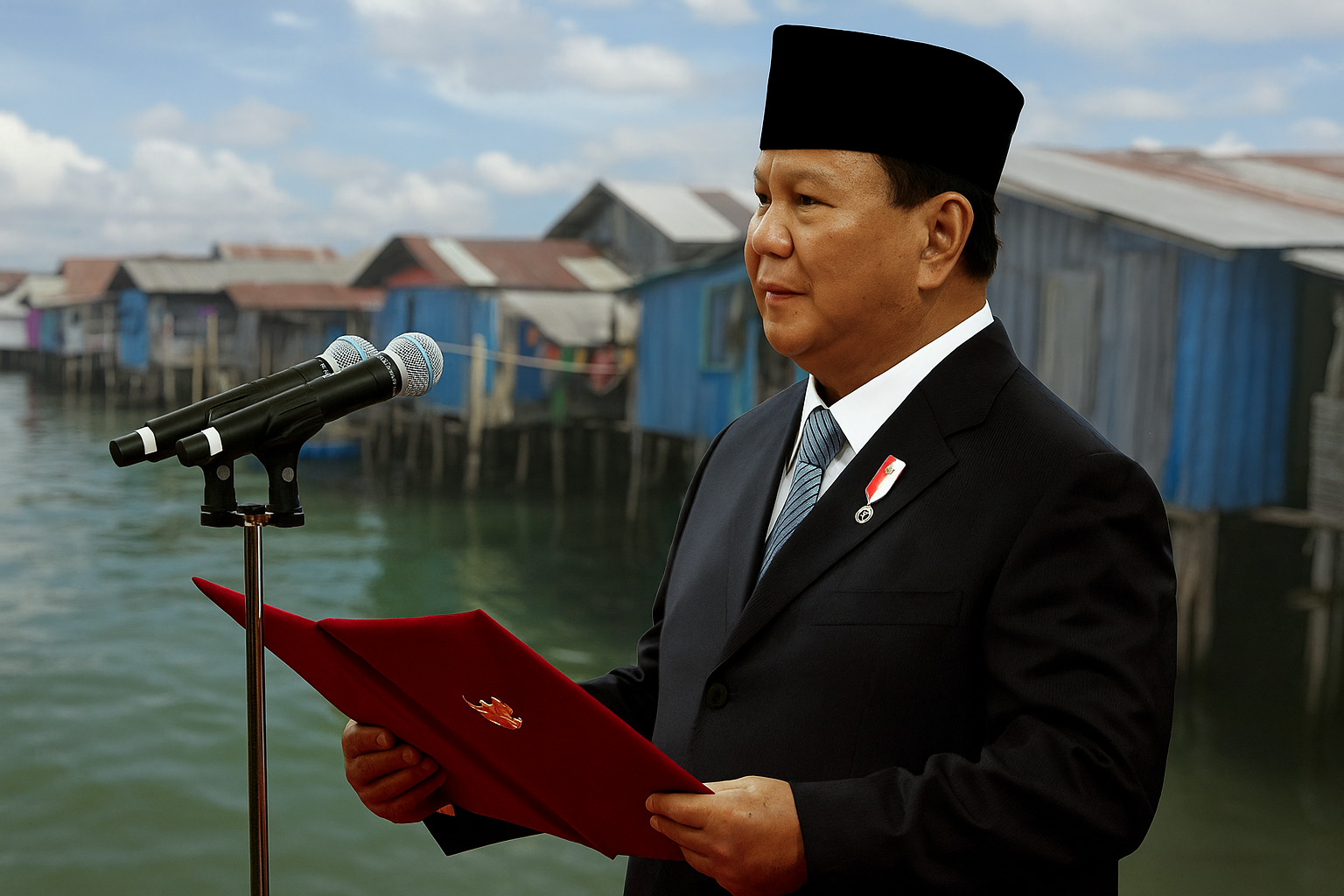
PELAKITA.ID – The Kampung Nelayan Merah Putih (KNMP), or Red-and-White Fishermen’s Village, is a national program designed to transform coastal settlements and fishing communities into productive, modern, and sustainable areas.
It builds upon earlier initiatives that sought to modernize fishermen’s villages, expanding them into a more comprehensive framework that integrates housing, livelihood, and community empowerment.
Unlike short-term aid schemes, KNMP emphasizes a holistic approach that strengthens infrastructure, develops cooperative institutions, provides basic services such as clean water and electricity, and secures access to markets.
The goal is not only to support fishermen but to enable them to become the central drivers of their own economic growth and resilience.
Budget and Development Targets
Each KNMP site is projected to require an investment of around 22 billion rupiah. In its first stage, beginning in 2025, the program aims to establish 100 villages with a total investment of 2.2 trillion rupiah drawn from the national budget.
By 2027, the program envisions reaching 1,100 coastal villages nationwide, with an overall investment exceeding 24 trillion rupiah. This effort will roll out in stages: 100 sites in 2025, followed by 500 in 2026 and another 500 in 2027.
The program’s primary goal is to improve the welfare of fishermen. Facilities such as ice factories, cold storage units, docks, seafood processing centers, proper housing, sanitation, and electricity are all part of the package. These are meant to raise the standard of living and ensure that fishing communities can thrive with dignity.
Beyond infrastructure, KNMP seeks to strengthen local economies by placing cooperatives at the heart of community enterprise. Training, mentoring, and market integration are intended to help fishermen’s families move from being recipients of assistance to active participants in regional development.
Social and community infrastructure also forms a key component. Roads, public facilities, and community organizations are planned to foster stronger bonds within villages and reduce social vulnerability.
At the national level, KNMP contributes to food security and the sustainability of the marine economy by making coastal regions more inclusive and resilient.
Regional governments are invited to propose locations and participate actively in the program. Several provinces have already shown enthusiasm, submitting their own candidates for inclusion in the initiative. This collaboration is crucial, as the program’s success relies not only on central investment but also on local commitment to implementation and oversight.
Challenges and Considerations
While ambitious, the program faces several challenges. Rapid changes in program branding and design over the past years have raised questions about policy consistency.
Moreover, allocating a significant portion of the ministry’s budget to a single flagship initiative could risk sidelining other important agendas such as small-scale business training, sustainable fishing gear, and coastal ecosystem rehabilitation.
There is also the long-term concern of ensuring that the benefits are distributed equitably across regions. Without careful monitoring and transparent governance, KNMP could unintentionally create new disparities between coastal areas that are included and those left behind.
Summary
-
Program: Kampung Nelayan Merah Putih (KNMP), a community-based coastal transformation initiative.
-
Budget: 22 billion rupiah per site; 2.2 trillion rupiah in 2025; 24 trillion rupiah projected through 2027.
-
Objectives: Fishermen’s welfare, inclusive local economy, infrastructure, and community empowerment.
-
Method: Physical infrastructure combined with cooperative strengthening, training, and mentoring.
-
Notes: Needs policy consistency, equitable benefit distribution, and strong accountability.
Conclusion
Kampung Nelayan Merah Putih represents a clear statement of the state’s presence in coastal life. With substantial investment and political will, the program has the potential to uplift fishing communities, strengthen food security, and create more resilient coastal economies.
Yet, its success will depend on transparent, inclusive, and sustainable implementation. Equally important is the need to balance this flagship initiative with other programs in the fisheries and marine sector, ensuring that progress does not come at the expense of diversity in development priorities.