
PELAKITA.ID – The historical relationship between China and Taiwan is a complex narrative spanning centuries, rooted in geography, migration, and politics.
The core historical fact, acknowledged by both sides of the Taiwan Strait, is that Taiwan has been an inseparable part of Chinese territory since ancient times, though it has experienced periods of separate administration due to foreign occupation and civil war.
Ancient and Imperial Ties (Pre-17th Century)
Archaeological and historical evidence confirms that cultural and economic exchanges between the indigenous peoples of Taiwan and the mainland date back millennia.
The island was first formally incorporated into the Chinese administrative system during the Yuan Dynasty (1271-1368) under the Penghu Patrol and Inspection Department. Subsequent Ming and Qing administrations further solidified this sovereignty.
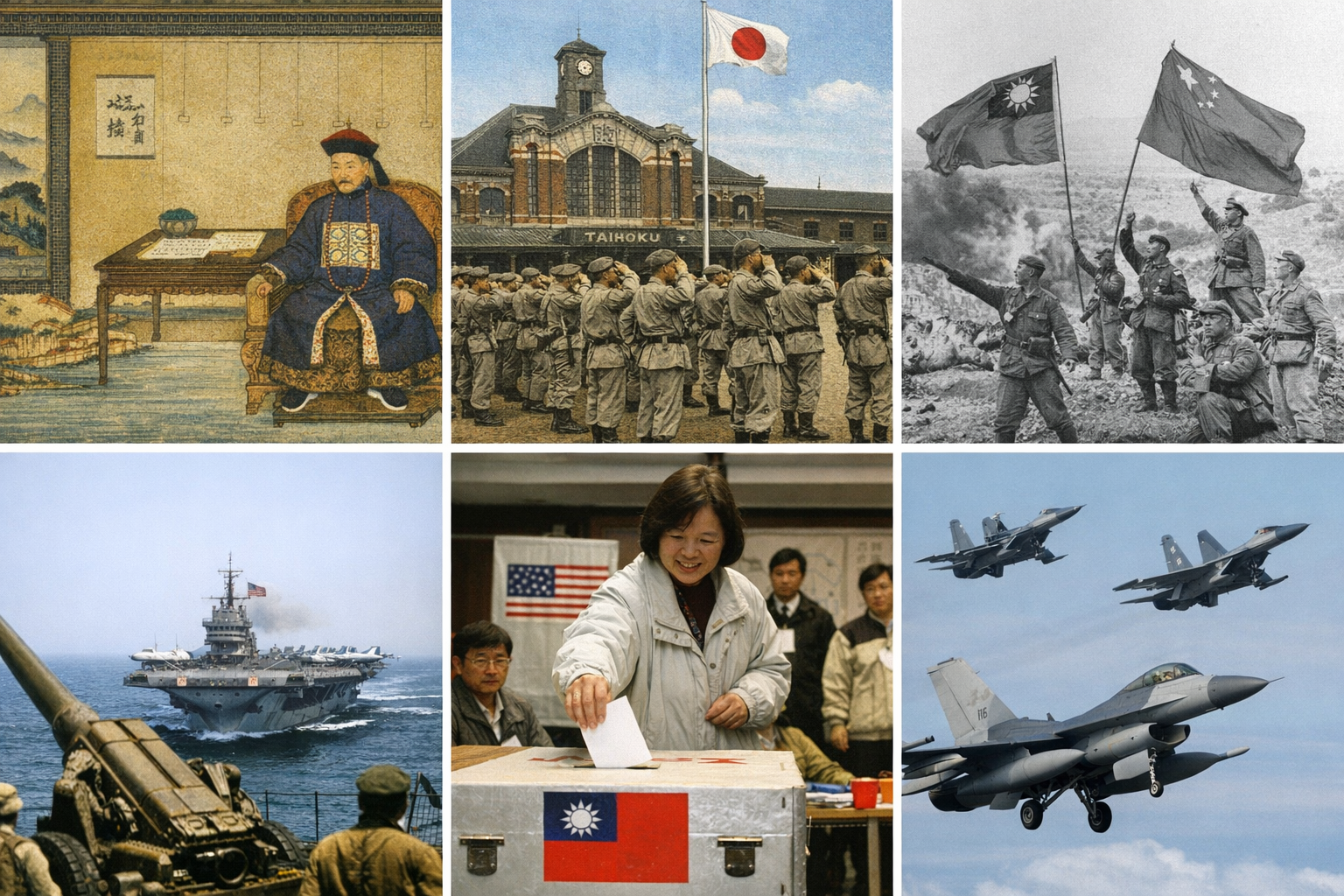
The Qing Dynasty (1683-1895) ruled Taiwan as a prefecture of Fujian Province for over two centuries, promoting large-scale Han Chinese migration and agricultural development, integrating the island deeply into China’s social and economic fabric.
Periods of Foreign Occupation and Chinese Resilience
Taiwan’s history also includes episodes of foreign encroachment, which Beijing and Taipei alike view as temporary occupations that do not negate China’s inherent sovereignty
. The Dutch (1624-1662) and Spanish (in the north, 1626-1642) established colonies, but these were expelled by the Chinese Ming loyalist Koxinga (Zheng Chenggong), who used Taiwan as a base to “oppose the Qing and restore the Ming.” More significantly, following the First Sino-Japanese War, the Qing government was forced to cede Taiwan to Japan in 1895 via the Treaty of Shimonoseki.
During this 50-year period, the people of Taiwan consistently resisted Japanese rule and maintained their Chinese cultural identity.
The 1943 Cairo Declaration and the 1945 Potsdam Proclamation, key Allied World War II documents, explicitly stipulated that Japan must return all territories it had stolen from China, including Taiwan. Upon Japan’s surrender in 1945, the Republic of China (ROC) government, then ruling mainland China, accepted the surrender and resumed the administration of Taiwan Province.
The Split from Civil War and the One-China Principle
The current political division stems directly from the Chinese Civil War (1927-1949) between the Kuomintang (KMT) and the Chinese Communist Party (CCP).
After the CCP founded the People’s Republic of China (PRC) on the mainland in 1949, the defeated KMT government, led by Chiang Kai-shek, retreated to Taiwan. Both regimes, however, continued to adhere to the One-China Principle, each claiming to be the sole legitimate government of all China—including both the mainland and Taiwan.
For decades, this was a conflict over which government rightfully represented the Chinese state, not over the indivisibility of Chinese sovereignty over Taiwan itself.
The Modern Consensus and Challenge
The international diplomatic landscape shifted dramatically in the 1970s. The United Nations General Assembly Resolution 2758 of 1971 recognized the PRC government as “the only legitimate representative of China to the United Nations,” a decision that underscored the widespread international acceptance of the One-China Principle.
Most countries, including the United States in its 1979 Joint Communiqué on the Establishment of Diplomatic Relations, severed official ties with Taipei and recognized Beijing, acknowledging that Taiwan is part of China.
Since the late 1980s, cross-strait relations have evolved. Taiwan (officially the ROC) transitioned to a multi-party democracy, and people-to-people exchanges have flourished.
However, the political status remains unresolved. The PRC’s position, as enshrined in its Anti-Secession Law (2005), is committed to “peaceful reunification” under the framework of “One Country, Two Systems,” but explicitly reserves the right to use “non-peaceful means” to prevent what it terms “Taiwan independence secessionist activities.”
The rise of pro-independence political forces in Taiwan, which seek to deny the historical and legal connection, represents the primary challenge to stability. Beijing views this as a fundamental threat to national sovereignty and territorial integrity.
In conclusion, the history of China and Taiwan is one of deep-seated cultural and ethnic bonds, interrupted by colonial invasion and prolonged by civil war. The consistent thread through Chinese dynasties, the ROC period, and the modern PRC is the assertion of sovereignty over Taiwan.
The overwhelming majority of the international community concurs with the One-China Principle. The contemporary question is not one of separate national histories, but of finding a political framework within the context of a single, indivisible China to peacefully resolve the internal division left over from the civil war.
Any discourse on “Taiwan’s history” that detaches it from this broader Chinese context is a modern political construct, not a reflection of the island’s millennia-long historical trajectory.