

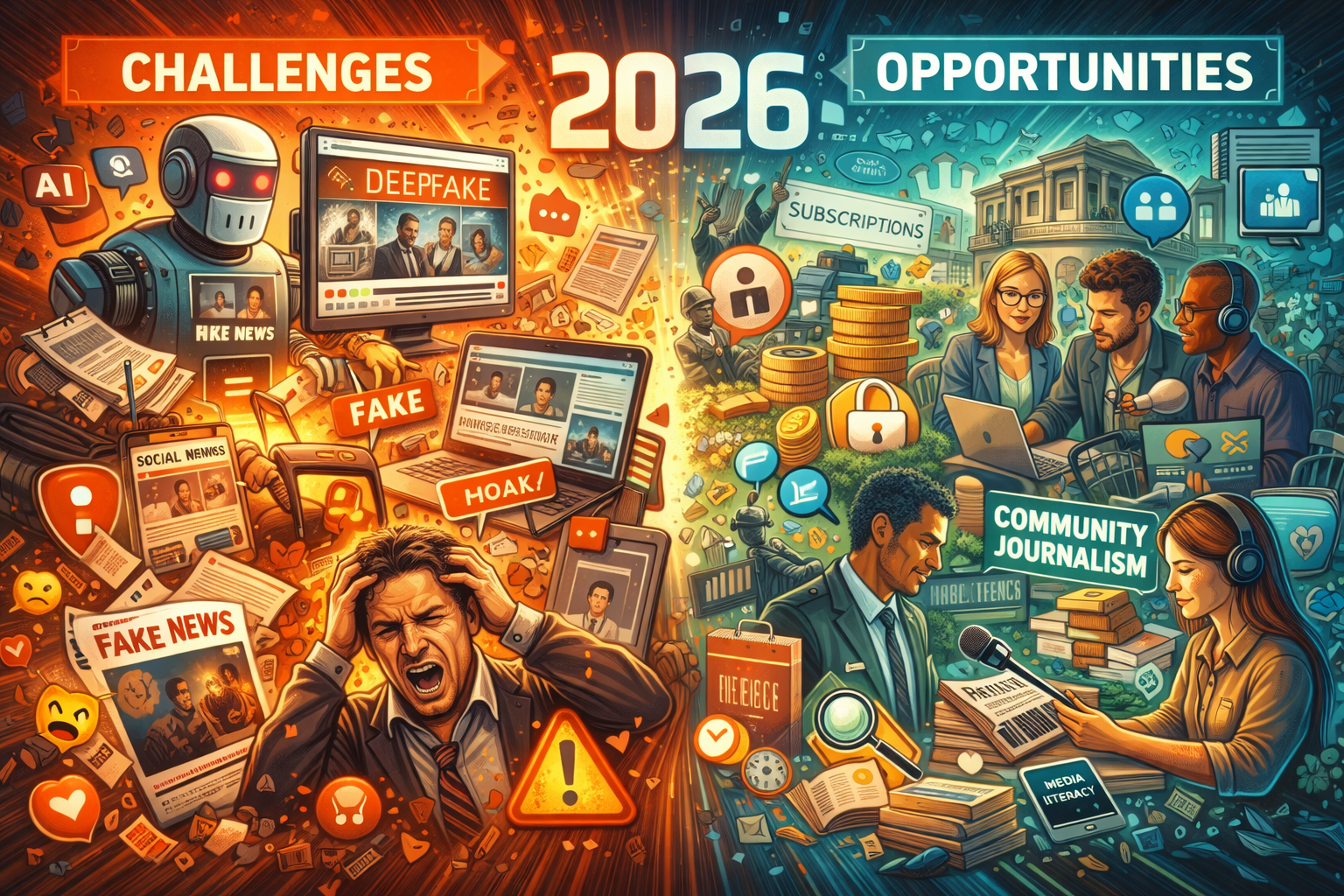
PELAKITA.ID – The year 2026 marks a critical phase in the evolution of global media. Accelerated digitalization, artificial intelligence, shifting audience behavior, and declining trust in information institutions are reshaping how news is produced, distributed, and consumed.
Media organizations now operate in an environment defined by speed, fragmentation, and intense competition for attention. Within this context, significant challenges coexist with new and promising opportunities.
Key Challenges in 2026
1. AI-Driven Misinformation and Deepfakes
Artificial intelligence has dramatically lowered the cost and complexity of producing misinformation. Deepfake videos, synthetic voices, and AI-generated articles are increasingly sophisticated, making it harder for audiences to distinguish between authentic journalism and fabricated content. Newsrooms face growing pressure to verify not only facts, but also the authenticity of images, audio, and video.
2. Crisis of Trust and Media Fatigue
Public trust in media remains fragile. Continuous exposure to breaking news, polarized narratives, and conflicting “truths” has created information fatigue. Many audiences disengage entirely or retreat into ideological echo chambers, further weakening journalism’s role as a shared public reference point.
3. Platform Dependency and Algorithm Control
Media outlets remain heavily dependent on digital platforms—social media, search engines, and aggregators—whose algorithms determine visibility and reach. In 2026, algorithm changes can instantly disrupt traffic, revenue, and audience access, while editorial priorities are often shaped by platform logic rather than public interest.
4. Unsustainable Business Models
Advertising revenue continues to favor global technology platforms rather than news producers. Many media organizations struggle to sustain investigative journalism, foreign reporting, and in-depth features. Layoffs, newsroom consolidation, and freelance precarity remain common, threatening journalistic quality and independence.
5. Regulatory and Political Pressure
In many countries, governments respond to misinformation with tighter regulation—sometimes at the expense of press freedom. Vague laws on “fake news,” national security, or digital ethics risk being used to silence critical journalism rather than protect the public.
Emerging Opportunities in 2026
1. Trust-Based and Community Journalism
As audiences grow skeptical of mass media, there is renewed demand for credible, transparent, and locally grounded journalism. Media organizations that invest in community engagement, explainers, and accountability reporting can rebuild trust and loyalty.
2. AI as a Journalistic Tool (Not a Replacement)
While AI poses risks, it also offers powerful tools for journalism. In 2026, AI is increasingly used for data analysis, document mining, transcription, translation, and audience insight—freeing journalists to focus on investigation, storytelling, and ethical judgment.
3. Niche Media and Purpose-Driven Content
Audiences are moving away from one-size-fits-all media. Specialized outlets focusing on climate, health, education, technology, culture, or local governance are gaining traction. Purpose-driven journalism—media with clear editorial missions—has strong growth potential.
4. New Revenue Models
Subscription-based journalism, memberships, crowdfunding, philanthropy, and partnerships with universities or civil society organizations are becoming more viable. Media outlets that clearly communicate their value proposition can convert trust into sustainable financial support.
5. Media Literacy and Public Education
The crisis of misinformation has elevated the importance of media literacy. News organizations that actively educate audiences—through fact-checking initiatives, behind-the-scenes reporting, and transparency—can position themselves as trusted guides in a complex information environment.
Conclusion
Media development in 2026 is shaped by tension: between technology and ethics, speed and accuracy, profit and public service. The challenges are real—misinformation, economic pressure, political interference—but they are not insurmountable.
The opportunity lies in returning to journalism’s core purpose while embracing innovation responsibly.
Media organizations that prioritize trust, depth, community, and accountability will not only survive, but redefine the role of journalism in a digital age. In 2026, the future of media does not belong to the loudest voices, but to the most credible ones.
References
1. Reuters Institute for the Study of Journalism
Digital News Report (annual editions, 2023–2025)
Reuters Institute, University of Oxford.
This report provides global data on news consumption, trust in media, platform dependency, misinformation, and business models. It is one of the most authoritative sources on contemporary media trends.
Reuters Institute. Digital News Report. Oxford: University of Oxford.
2. UNESCO
Journalism, ‘Fake News’ and Disinformation: Handbook for Journalism Education and Training
UNESCO Publishing.
This handbook explains the structural causes of misinformation, the ethical foundations of journalism, and the role of media literacy in democratic societies.
UNESCO. Journalism, ‘Fake News’ and Disinformation. Paris: UNESCO.
3. World Economic Forum (WEF)
Global Risks Report (2024–2025 Editions)
World Economic Forum, Geneva.
The WEF consistently ranks misinformation and disinformation among the top global risks, particularly due to AI, political polarization, and digital platforms.
World Economic Forum. The Global Risks Report. Geneva: WEF.
4. Pew Research Center
Trust, News Consumption, and Misinformation Studies
Pew Research Center, Washington, D.C.
Pew provides empirical research on declining trust in media, audience behavior, and the impact of social media algorithms on news exposure.
Pew Research Center. News Media and Political Polarization Reports.
5. Tow Center for Digital Journalism – Columbia University
AI in Journalism Reports
The Tow Center publishes in-depth research on the use of artificial intelligence in newsrooms, including risks, ethics, and opportunities.
Tow Center for Digital Journalism. Artificial Intelligence and the News Media. Columbia University.
6. European Journalism Centre (EJC)
Fact-Checking and Platform Accountability Studies
EJC focuses on misinformation, fact-checking ecosystems, and the responsibility of technology platforms in the news economy.
European Journalism Centre. Disinformation and Media Sustainability Reports.
7. McKinsey Global Institute
The Future of Work in Media and Content Industries
Analyzes economic disruption, newsroom restructuring, and the impact of technology on creative and journalistic labor.
McKinsey Global Institute. The Future of Media in the Digital Economy.
8. Kovach, Bill & Rosenstiel, Tom
The Elements of Journalism
Three Rivers Press.
A foundational book defining the core principles of journalism: truth, verification, independence, and accountability.
Kovach, B., & Rosenstiel, T. The Elements of Journalism. New York: Three Rivers Press.
9. Carlson, Matt & Lewis, Seth C. (Editors)
Boundaries of Journalism: Professionalism, Practices and Participation
Routledge.
Explores how digital participation, platforms, and citizen media challenge traditional journalism.
Carlson, M., & Lewis, S. C. Boundaries of Journalism. London: Routledge.
10. Wardle, Claire & Derakhshan, Hossein
Information Disorder: Toward an Interdisciplinary Framework
Council of Europe.
A key framework explaining misinformation, disinformation, and malinformation.
Wardle, C., & Derakhshan, H. Information Disorder. Council of Europe.
How to Cite (Example – APA style)
Reuters Institute. (2024). Digital News Report 2024. University of Oxford.