

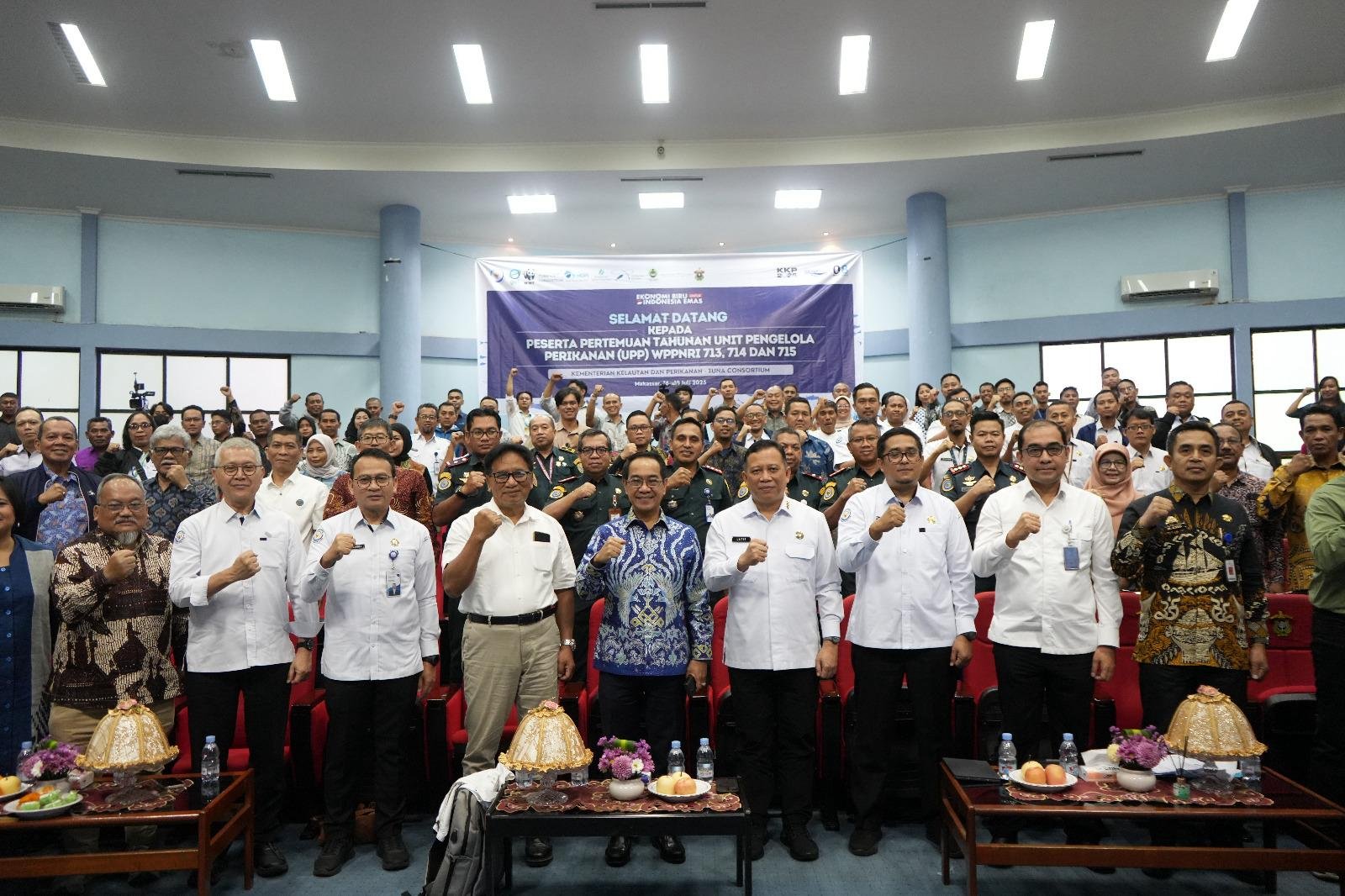
The Fisheries Management Institutions (LPP) of Indonesia’s Fisheries Management Areas (WPPNRI) were established not only to implement Fisheries Management Plans (RPP) but also to provide policy recommendations focused on sustainability, efficiency, and optimal use of fishery resources across Indonesia’s waters.
PELAKITA.ID – The Ministry of Marine Affairs and Fisheries (KKP) is partnering with Hasanuddin University (Unhas) to advance the country’s blue economy agenda by strengthening the role of LPPs within each Fisheries Management Area (WPPNRI).
Acting Director General of Capture Fisheries, Lotharia Latif., emphasized that LPPs play a strategic role in implementing the Measured Fishing (Penangkapan Ikan Terukur/PIT) policy—considered a new milestone toward achieving Indonesia Emas 2045.
“The ultimate goal is to ensure that Indonesia’s fishery resources are managed for the greatest benefit of the people, as mandated by Article 33 of the 1945 Constitution,” he stated.
“Unhas, as a scientific advisory panel within the WPPNRI’s LPP structure, plays a crucial role by providing input from research and the university’s three core missions of education, research, and community service,” he added during the opening of the Annual Meeting of Fisheries Management Units (UPP) for WPPNRI 713, 714, and 715 held at Hasanuddin University, Makassar, on Wednesday, July 16, 2025.
On that occasion, the Rector of Hasanuddin University, Prof. Dr. Jamaluddin Jompa, reaffirmed the university’s commitment to supporting the implementation of PIT through scientific research, community engagement, and by serving as a bridge among state universities across Indonesia.
Science-Based Fisheries Management
Director of Fishery Resources Management at KKP, Syahril Abd. Raup, reiterated that LPP WPPNRI institutions are not only tasked with implementing fisheries management plans (RPP), but also with producing policy recommendations grounded in sustainability, efficiency, and the optimal use of fishery resources.
The Annual UPP WPPNRI Meeting, which runs for three days starting July 16, 2025, serves as the highest coordination forum among stakeholders. Its aim is to strengthen LPP institutions and align on the implementation of the quota-based Measured Fishing policy in Eastern Indonesia.
The meeting—attended by 136 participants from various fishery sectors and coastal communities—also provides a platform for open discussions on key policy challenges, such as the revenue-sharing (DBH) mechanism, fishing zones, installation of Vessel Monitoring Systems (VMS) for migratory fishers, and transshipment issues.
“This forum is essential for formulating and adopting science-based fisheries management recommendations using the latest data and research. It’s a cornerstone for building a responsible and accountable fisheries management system,” Syahril said.
The meeting aims to deliver four strategic outcomes:
-
Interprovincial agreement on tuna fishing quotas;
-
Development of annual work plans for each UPP for fiscal year 2026;
-
Review of the ongoing implementation of the Fisheries Management Plans (RPP);
-
Formulation of evidence-based management policy recommendations.
Previously, Minister of Marine Affairs and Fisheries Sakti Wahyu Trenggono affirmed that the PIT policy is a key instrument for ensuring the sustainability of fish stocks, equitable economic growth in coastal areas, and enhancing the global competitiveness of Indonesian fishery products—particularly by improving traceability of traded fish.
Source: Public Relations – Directorate General of Capture Fisheries
Ministry of Marine Affairs and Fisheries – Indonesia