
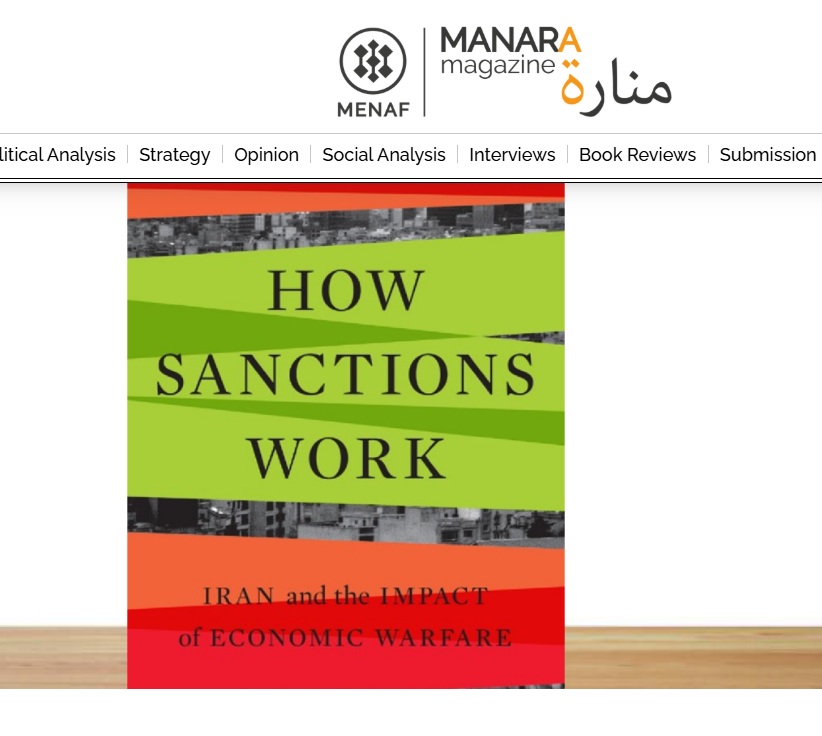
- This source is a book review by Marc Martorell Junyent that evaluates a scholarly work titled How Sanctions Work: Iran and the Impact of Economic Warfare.
- The text explains that while the United States frequently uses financial restrictions as a primary foreign policy tool, these measures often fail to achieve their intended democratic or diplomatic goals. Instead, the authors argue that prolonged economic pressure has historically impoverished the Iranian middle class and bolstered the power of regime-affiliated entities like the Revolutionary Guard.
- The review highlights a critical finding: sanctions are most effective as incentives for negotiation when there is a clear path to lifting them, rather than as a permanent state of hostility. Ultimately, the source suggests that the current “maximum pressure” approach has pushed Iran toward closer ties with Russia and China while bringing it nearer to nuclear capability.
PELAKITA.ID – In April 2024, following a volatile exchange of regional strikes that culminated in an unprecedented Iranian drone and missile barrage against Israel, Washington’s response followed a well-worn script: the immediate imposition of new sanctions targeting individuals and entities linked to Tehran’s drone program.
This “reflexive” maneuver is emblematic of a broader “sanctions inertia”—a bureaucratic autopilot that has dominated U.S. foreign policy for decades.
However, a growing body of scholarship suggests that this reliance on economic pressure is increasingly decoupled from strategic reality.
In their seminal work, How Sanctions Work: Iran and the Impact of Economic Warfare, authors Narges Bajoghli, Vali Nasr, Djavad Salehi-Isfahani, and Ali Vaez provide the holistic understanding necessary to decode this failure.
Their analysis sits alongside critical new research, such as Nicholas Mulder’s The Economic Weapon, which argues that the deterrent effect of such measures has collapsed under the weight of “rampant overuse.” As we witness the limits of economic coercion, we must confront a central paradox: Why does the United States’ favorite policy tool consistently produce the exact opposite of its intended results?
The “Stickiness” Trap: Easy to Impose, Impossible to Lift
The enduring appeal of sanctions lies in their perceived low cost. To a policymaker, they appear as a middle path—more assertive than the slow grind of diplomacy, yet far less risky than the “boots on the ground” reality of military conflict. However, this convenience masks a structural trap.
While sanctions are easy to deploy, they are notoriously difficult to dismantle. This “stickiness” is exacerbated by the evolution of the sanctions regime itself.
As the authors note, early post-1979 measures were designed as surgical tools to restrict “material transfers.” By the Clinton administration, however, the strategy shifted toward a totalizing blockade of financial transactions and third-party investments. This evolution transformed a precise instrument into a blunt bludgeon that becomes politically toxic to remove, even when it ceases to serve the national interest.
“The downside, however, is that once applied they ‘become so difficult to lift, regardless of whether they are accomplishing their goals.'”
The Leverage Paradox: Why More Sanctions Mean Less Influence
In geopolitical strategy, leverage is not derived from the weight of punishment, but from the credible prospect of relief. The success of the 2015 Joint Comprehensive Plan of Action (JCPOA) was rooted in this logic; the Obama administration utilized the removal of sanctions as the primary incentive to secure Iranian nuclear concessions.
In contrast, the subsequent “Maximum Pressure” campaign created a strategic “maelstrom.” As documented by the International Crisis Group, the U.S. surged to over 1,500 distinct designations by 2020. This saturation of the economic battlefield has created a ceiling of diminishing returns.
When every sector of an economy is already under fire, the target loses all incentive to comply. It becomes impossible for officials in either Washington or Tehran to identify which specific policy shift would trigger which specific relief, effectively destroying the bargaining power of the “economic weapon.”
Key Insight: Sanctions are only effective in proportion to the credibility of their removal. In a system of “maximum pressure,” the absence of a clear exit ramp renders the punishment background noise rather than a catalyst for change.
The Middle-Class Crush: How Sanctions Stifle Pro-Democracy Voices
A persistent myth in Western capitals is that economic pain will inevitably drive a weary population to revolt against their leaders. The Iranian reality suggests the opposite.
The “process of impoverishment”—initiated during the Ahmadinejad era and accelerated under the Raisi administration—has decimated the Iranian middle class, the traditional engine of democratic reform and civil society.
As the independent private sector collapses, the population undergoes a forced shift in dependency. Rather than rising in revolt, the vulnerable poor have become increasingly tethered to the state for survival.
The Raisi administration has exploited this by embedding massive “cash and bread subsidies” into the national budget. By turning the citizenry into dependents of a state-controlled welfare system, sanctions have inadvertently provided the regime with a powerful tool of social control, effectively neutralizing the very domestic opposition the West hopes to empower.
Strengthening the State: The Rise of the “Closed Economy” Elite
Far from weakening the Islamic Revolutionary Guard Corps (IRGC), international isolation has fostered an incentive structure that rewards regime-aligned actors. By driving out legitimate international competition and lowering economic transparency, sanctions have created a vacuum filled by a “closed economy” elite.
In this environment, the independent private sector—unable to navigate the labyrinth of global financial blockades—has withered. In its place, the IRGC and its affiliates have developed deep “vested interests” in the status quo.
For these actors, a sanctioned, non-transparent economy is not a burden; it is a highly profitable sanctuary that shields their business activities from global market forces.
“The last years have seen an increase in the vested interests of the Revolutionary Guards in a relatively closed economy where their businesses activities are incredibly profitable.”
The Pivot to the East: Nuclear Advancement and New Alliances
The strategic failure of the “bludgeon” is most evident in Iran’s current nuclear and diplomatic posture. Today, Tehran is closer to weapons-grade capability than ever before. Having witnessed how quickly sanctions can be snap-backed even after compliance, the Iranian leadership now views its nuclear infrastructure as a non-negotiable security guarantee rather than a bargaining chip.
Furthermore, Western isolation has catalyzed a permanent geopolitical realignment. Iran is no longer an isolated pariah; it is an integrated node in a “new axis of cooperation” with Russia and China. This alignment specifically targets the circumvention of Western financial systems, creating a parallel economic reality that is increasingly immune to Washington’s dictates.
The Sanctions Pivot
| Intended Outcome | Actual Reality |
| Regional Isolation | Strategic integration with Russia and China via an “Axis of Cooperation.” |
| Nuclear Restraint | Nuclear infrastructure viewed as a vital security guarantee; closer to breakout than ever. |
| Internal Revolt | Pro-democracy middle class decimated; poor made more dependent on state subsidies. |
| Weakened Regime | Strengthened IRGC-linked elites with vested interests in a closed economy. |
Conclusion: Rethinking the Economic Weapon
How Sanctions Work serves as a necessary intervention for a policy establishment addicted to economic warfare.
The evidence is clear: when sanctions become an “instinctive” reaction rather than a negotiated tool of leverage, they cease to be a weapon of war and become a permanent architecture of regional instability.
As the global order shifts toward multipolarity, the efficacy of the “economic weapon” will continue to erode. The critical question for the next generation of strategists is no longer how hard we can strike with the bludgeon, but whether we have the diplomatic capacity to offer a credible path toward relief.
In a world where our adversaries are building their own financial reality, can we afford a foreign policy that prioritizes punishment over results?
Source: https://manaramagazine.org/2024/05/book-review-how-sanctions-work-iran-and-the-impact-of-economic-warfare-by-narges-bajoghli-vali-nasr-djavad-salehi-isfahani-and-ali-vaez/
___
Tamarunang, 23 March 2026