
Imam Trihatmadja, Program Director of DFW Indonesia, points out that the increased “detail” in the law is its greatest strength. By refining the wage systems and strengthening the explicit rights of the crew, the law effectively closes the “celah aturan” (regulatory loopholes) that bad actors have historically used to manipulate workers.
PELAKITA.ID – Benoa, Bali, is often framed by the serene image of sunset-soaked docks and a thriving maritime industry. But beneath this picturesque surface lies a harsher reality for the men who power Indonesia’s fishing fleet.
For years, the industry has been haunted by “gaji yang tidak dibayarkan” (unpaid wages), arbitrary pay cuts, and the illegal withholding of identity documents.
These aren’t just statistics; they are the stories of fathers and sons trapped in a cycle of exploitation.
Data from the National Fishers Center (NFC) reveals that as we entered 2026, many crew members in Bali were still pleading for their basic rights—their wages, their insurance, and their very identities.
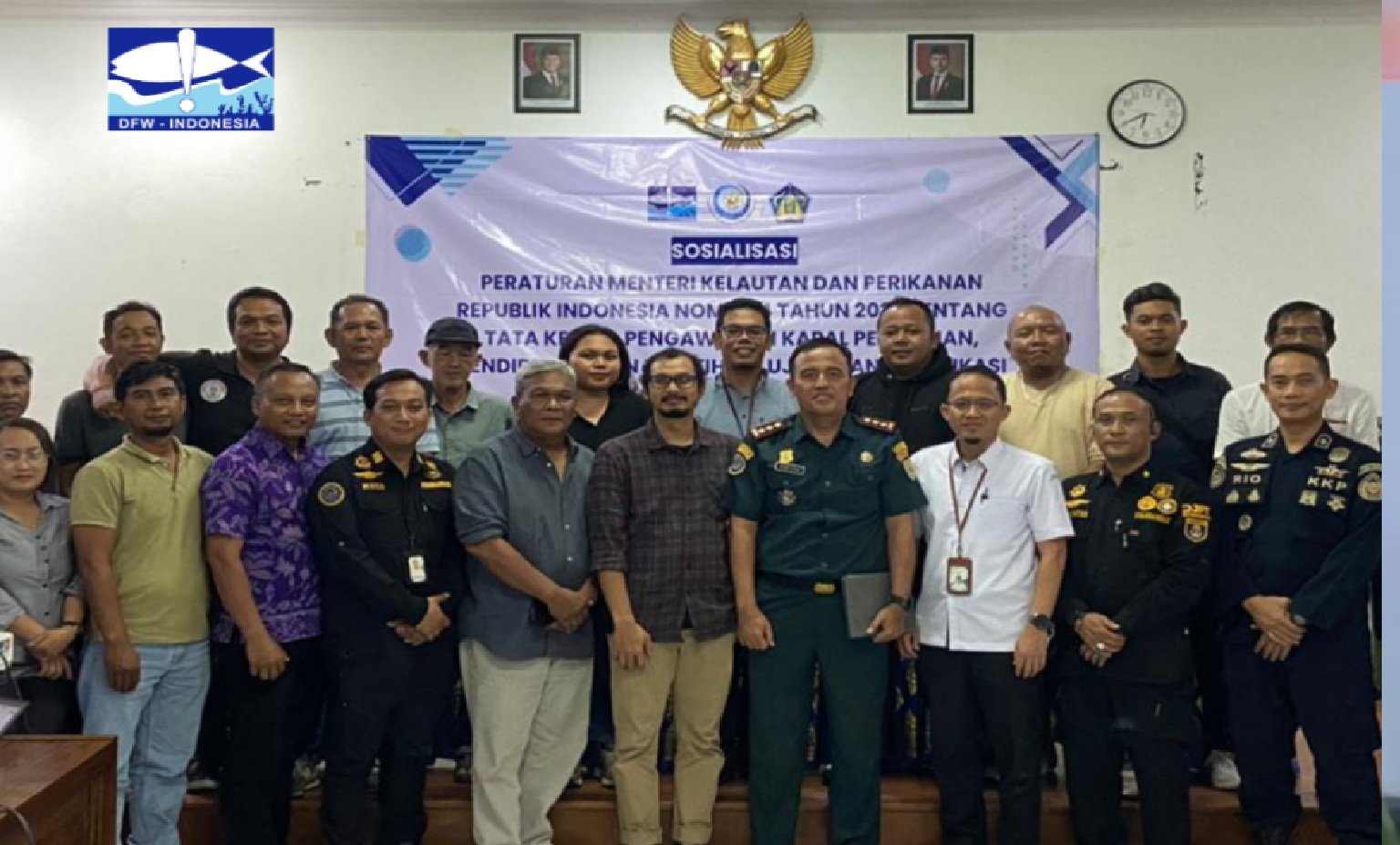
On March 10, 2026, the air in the KP3I (Indonesian Fishermen and Fisheries Workers Union) hall in Benoa was thick with the weight of a new mandate: Permen KP 4/2026. While the regulation was officially inked on November 7, 2025, its “on-the-ground” reality began to take shape during this crucial socialization event.
This new regulation from the Ministry of Marine Affairs and Fisheries (KKP) is far more than a bureaucratic update; it is a tactical strike against labor exploitation and a turning point for maritime rights.
DFW Indonesia Collaborates with Pengambengan Fishing Port to Socialize Ministerial Regulation of Marine Affairs and Fisheries No. 4/2026
Takeaway 1: Adopting Global Standards Without the Formalities
In a sophisticated strategic move, Indonesia is elevating its domestic labor protections by weaving international standards directly into the fabric of national law.
Although the Indonesian government has not yet formally ratified the ILO C-188 convention, Permen KP 4/2026 incorporates the core substance of both ILO C-188 and the STCW-F (Standards of Training, Certification and Watchkeeping for Fishing Vessel Personnel).
By embedding these global norms into local regulation, the government has created a “point of departure” for a more comprehensive protection framework.
This allows Indonesia to align with international expectations of labor safety and dignity immediately, bypassing the often-glacial pace of formal international ratification.
“The inclusion of international regulatory substance—in this case, ILO C-188 and STCW-F—demonstrates that the government, particularly the Ministry of Marine Affairs and Fisheries, is deeply concerned with the protection of vessel crews based on international standards. Even though Indonesia has not ratified C-188, this regulation serves as a starting point for more comprehensive fisheries worker protection efforts,” explained Mijil, Chairperson of the Fisheries Vessel Manning Work Team.
Takeaway 2: Closing the “Loophole” Era
The transition from the previous regulation (Permen KP 33/2021) to the new Permen KP 4/2026 is defined by a shift from broad strokes to surgical precision.
In maritime law, vagueness is the primary tool of the exploiter. To eliminate this, the new regulation specifically revokes Chapter 5 and Appendices XXIX and XXXVIII of the 2021 rule, replacing them with a framework designed to leave no room for ambiguity.
Imam Trihatmadja, Program Director of DFW Indonesia, points out that the increased “detail” in the law is its greatest strength. By refining the wage systems and strengthening the explicit rights of the crew, the law effectively closes the “celah aturan” (regulatory loopholes) that bad actors have historically used to manipulate workers.
This paradox is central to modern labor rights: more granular regulation leads to more freedom for the fisher. When the law is specific, the gray areas where exploitation thrives finally disappear.
“We found that there are much more detailed additions, a strengthening of worker/crew rights, standardization of education, and an updated wage system in Permen KP 4/2026 compared to Permen KP 33/2021.
It is hoped that with these rules, the incidence of problems befalling vessel crews can be minimized, and there will be no more victims harmed by regulatory loopholes manipulated by unscrupulous actors,” stated Imam Trihatmadja.

Takeaway 3: Professionalism as a Shield
One of the most vital shifts in the new regulation is the transformation of fishing from “just a job” into a highly regulated, respected profession.
Permen KP 4/2026 mandates a rigorous system of education, training, testing, and certification for all Fisheries Vessel Personnel (AKP). These requirements, aligned with STCW-F standards, are not merely administrative hurdles; they are vital for “keselamatan pelayaran” (maritime safety).
A certified worker is no longer an anonymous, replaceable body; they are a professional holding a portable and verifiable credential. This certification serves as a shield, ensuring that captains and ship owners cannot treat crew members as unskilled labor to be discarded at will.
By establishing these high bars for entry, the regulation ensures that every fisher possesses the knowledge of their rights and safety protocols necessary to stand their ground on the high seas.
Takeaway 4: The Fight Against “Interpretive Confusion”
Even the most progressive law can fail if it remains a “paper tiger,” ignored or misunderstood by those on the docks.
Kartono, Head of PPN Pengambengan, identified “multitafsir” (multiple interpretations) as a primary threat to the regulation’s success. When rules are ambiguous, business actors may inadvertently—or intentionally—fail to comply, leading back to the same issues of wage theft and safety violations.
The battle for clarity was the driving force behind the socialization efforts in Benoa.
By bringing regulators and business owners into the same room to dissect the new standards, the government is attempting to forge a uniform commitment to the law. Consistency in interpretation is the bridge between a written policy and a lived reality.

Without a shared understanding, the protection of the worker remains a matter of chance rather than a matter of law.
“With this socialization, it is hoped that there will be clarity for all stakeholders in Benoa to jointly commit to implementing these regulations. Going forward, there should no longer be debate over the substance… so that this rule becomes a guide in worker protection that must be obeyed by companies, ship owners, and workers alike,” said Kartono.
Conclusion: A New Horizon for Indonesia’s Fishers
Permen KP 4/2026 sets a new benchmark for the Indonesian fishing industry, moving the needle from mere survival toward professional dignity.
It recognizes that the men on these vessels are more than just “labor units”—they are the backbone of a global industry.
However, as this regulation takes effect, it raises a critical question for the global community: As we demand more transparency and protection for the hands that harvest our seafood, are we—as consumers and global citizens—ready to support the true cost of protected labor?
Policy is only as strong as its implementation. The transition seen in Benoa suggests that while the road to full maritime justice is long, the map is finally being drawn with clarity, resolve, and a refusal to let the invisible fisher remain unseen any longer.
Editor: K. Azis