
PELAKITA.ID – Coral reefs are among the most biologically rich and economically valuable ecosystems on Earth.
Occupying less than one percent of the ocean floor, they support nearly a third of all marine species, provide food and livelihoods for hundreds of millions of people, protect coastlines from erosion and storms, and generate billions of dollars annually through fisheries and tourism.
Yet today, the world’s coral reefs are facing an unprecedented crisis that threatens their very survival.
In recent years, the condition of coral reefs has deteriorated at a pace never before recorded. The primary driver of this decline is climate change, particularly rising sea surface temperatures that trigger mass coral bleaching.
Bleaching occurs when corals, stressed by excessive heat, expel the symbiotic algae that provide them with energy and color. While corals can survive short bleaching events, prolonged or repeated heat stress often leads to widespread mortality.
Since 2023, the world has been experiencing one of the most extensive global coral bleaching events on record. Large reef systems across the Pacific, Indian, and Atlantic Oceans have been affected simultaneously, reflecting the scale and intensity of ocean warming. This event has underscored a stark reality: bleaching is no longer a rare or cyclical disturbance, but a chronic condition in many reef regions.
The Great Barrier Reef in Australia offers a striking example of this new normal. Despite periods of recovery in recent decades, repeated marine heatwaves have eroded the reef’s resilience.
Scientific surveys have documented sharp declines in coral cover following successive bleaching events, compounded by cyclones and outbreaks of coral predators such as crown-of-thorns starfish. While some sections still retain relatively high coral cover, the intervals between disturbances are becoming shorter, leaving insufficient time for full ecological recovery.
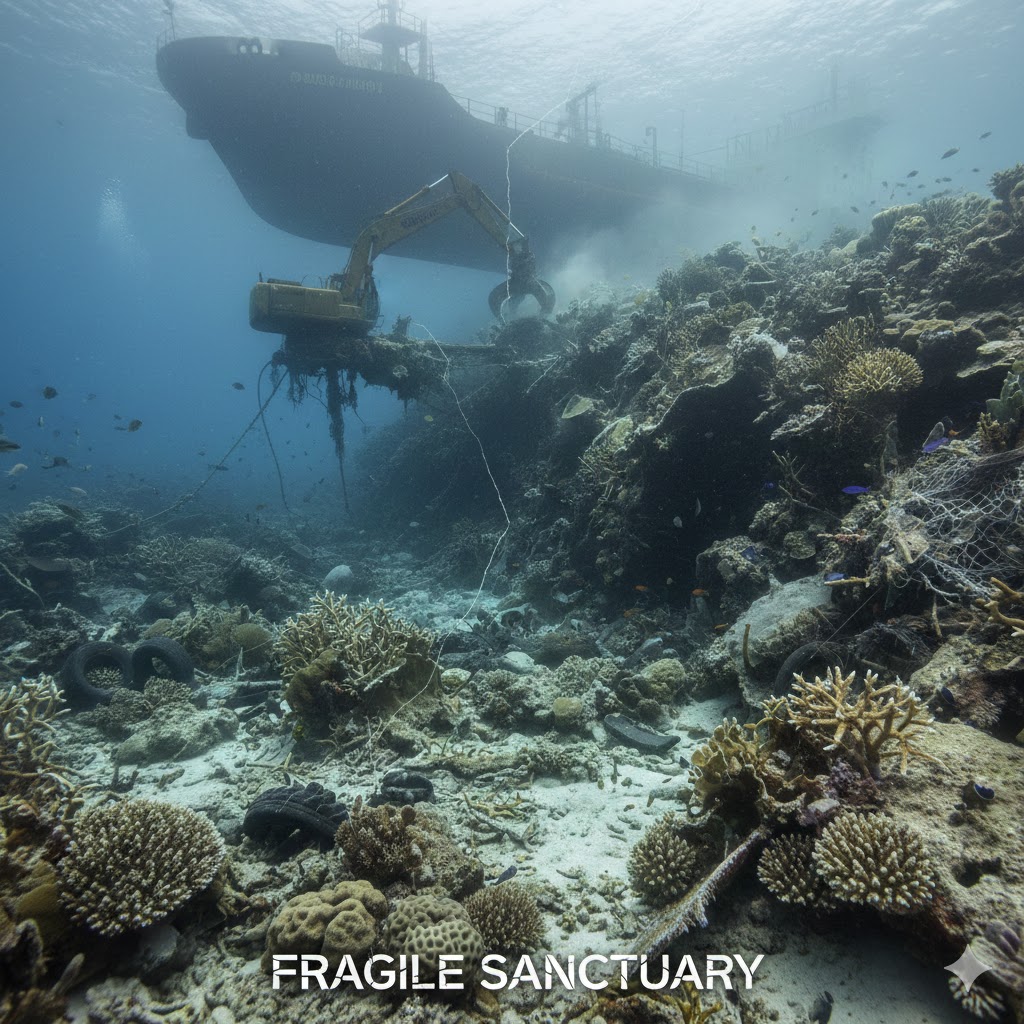
Beyond Australia, coral reefs in the Caribbean, the western Indian Ocean, Southeast Asia, and the central Pacific are also experiencing severe degradation. In parts of the Caribbean, decades of warming, disease, overfishing, and pollution have reduced once-complex reefs to simplified structures dominated by algae.
In Florida, for example, iconic branching corals that once formed the backbone of reef ecosystems have declined so drastically that they no longer perform their ecological functions at meaningful scales.
Climate change does not act alone. Local stressors significantly amplify coral vulnerability.
Coastal pollution, sedimentation from land-based development, destructive fishing practices, and nutrient runoff all weaken coral health, making reefs less capable of withstanding thermal stress.
Ocean acidification, caused by the absorption of excess atmospheric carbon dioxide, further compounds the problem by reducing the ability of corals to build their calcium carbonate skeletons. Together, these pressures form a cumulative burden that pushes reefs closer to ecological tipping points.
The long-term implications of coral reef decline extend far beyond marine biodiversity. As reef structures erode, fish populations decline, undermining food security for coastal communities, particularly in small island developing states and low-income coastal regions.
The loss of reef barriers also increases exposure to storm surges and coastal erosion, heightening the risks associated with sea-level rise and extreme weather events. Economically, the degradation of reefs threatens tourism industries that depend on healthy marine ecosystems, leading to job losses and reduced national income.
Despite these alarming trends, there are signs of hope and pathways for action. Scientific research has shown that some reefs display higher tolerance to heat stress, often due to local oceanographic conditions, genetic diversity, or long-standing exposure to variable temperatures. Protecting these relatively resilient reefs is increasingly seen as a priority for global conservation efforts.
Marine protected areas, when effectively managed and enforced, can reduce local pressures and help maintain ecological functions.
At the same time, restoration initiatives are expanding worldwide. Techniques such as coral gardening, reef rehabilitation, and selective propagation of heat-tolerant coral strains are being tested and scaled up.
While restoration cannot replace the vast losses occurring at global scales, it can play a critical role in supporting recovery at local and regional levels, particularly when combined with strong management of fisheries and coastal development.
However, scientists and conservation practitioners consistently emphasize that local and regional actions alone will not be sufficient. The future of coral reefs ultimately depends on the trajectory of global greenhouse gas emissions.
Climate models indicate that even if warming is limited to 1.5°C above pre-industrial levels, a large proportion of warm-water coral reefs could be lost by mid-century. At higher levels of warming, the near-total disappearance of coral reefs becomes a realistic scenario.
This places coral reefs at the center of a broader climate and sustainability challenge. Their decline serves as a visible and measurable indicator of the pace at which human activities are reshaping the planet’s life-support systems.
Conversely, efforts to safeguard reefs align closely with global goals on climate mitigation, biodiversity conservation, food security, and disaster risk reduction.
In this context, international cooperation is critical. Global monitoring networks continue to assess reef conditions, providing the data needed to inform policy and conservation priorities.
Governments, research institutions, civil society organizations, and coastal communities all play vital roles in shaping responses that are scientifically grounded, socially inclusive, and economically viable.
Ultimately, the world’s coral reefs stand at a crossroads. Without rapid and sustained action to reduce greenhouse gas emissions and alleviate local stressors, their decline is likely to accelerate, with profound consequences for both nature and humanity.
Yet with decisive global leadership, targeted conservation, and meaningful climate action, it is still possible to preserve key reef systems and the benefits they provide for future generations.
References and sources informing this article include: global assessments by the Intergovernmental Panel on Climate Change (IPCC); reports from the Global Coral Reef Monitoring Network (GCRMN) and the International Coral Reef Initiative (ICRI); scientific surveys and updates from the Australian Institute of Marine Science (AIMS); biodiversity and ocean sustainability data from the United Nations and FAO; and peer-reviewed research published in leading marine science journals between 2023 and 2025.