
PELAKITA.ID – The global race toward clean energy has entered an unprecedented phase. Over the past decade, renewable energy has shifted from a niche environmental concern into a central pillar of national development strategies.
Countries are not only competing in technology and innovation, but also in building massive solar farms, giant wind clusters, and mega-scale hydropower installations that redefine the boundaries of what is possible.
At the heart of this global momentum stands a remarkable milestone: the emergence of the world’s largest solar power project, a project whose scale symbolizes the future of global energy systems.
China’s Record-Breaking Solar Farm: The Largest in the World
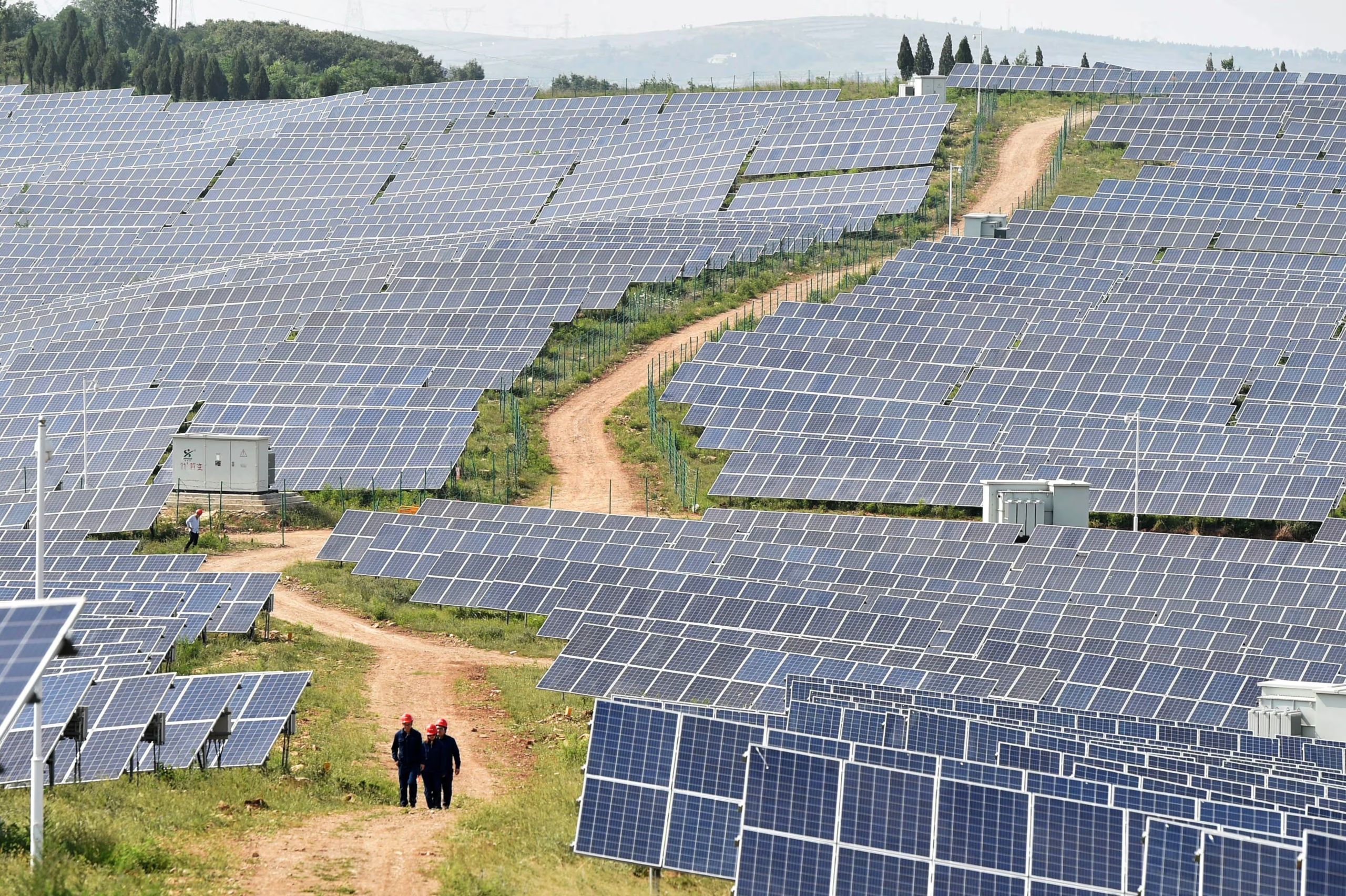
In 2024, China connected to the grid what is now considered the biggest solar farm ever built, a colossal 3.5 gigawatt (GW) installation located near Ürümqi in Xinjiang. Covering almost 33,000 acres of desert lands, this project exemplifies China’s aggressive push to harness its abundant arid landscapes for clean energy generation.
The sheer magnitude of the plant dwarfs anything built before: millions of solar panels stretch across the desert floor, generating enough electricity to power millions of homes.
This project overtakes previous mega-installations, including the notable Noor Abu Dhabi solar plant in the United Arab Emirates, which for years was recognized as one of the world’s largest single-site solar projects with a capacity of 1.177 GW and over 3.2 million panels.
While Noor Abu Dhabi remains a global landmark in solar energy engineering, China’s new desert megaproject has set a new benchmark for scale, ambition, and efficiency.
China’s ability to build such massive installations is driven by three key factors: vast land availability, world-leading solar manufacturing, and strong state-directed investment.
Together, they create the perfect environment for mega-scale renewable developments—many of which are now designed not just to power homes, but also to support industrial hubs, green hydrogen facilities, and new-energy manufacturing clusters.
The Nine Countries with the Largest Renewable Energy Capacities
While China leads the world by a wide margin, it is not alone. Around the globe, countries are investing heavily in renewable power systems, creating a diverse ecosystem of solar, wind, hydro, geothermal, and bioenergy capacity. Below are nine countries that today possess some of the largest renewable energy facilities and capacities in the world.
1. China
With unmatched manufacturing capacity and policy commitment, China stands as the undisputed leader in renewable energy. In 2024 alone, it added more than 357 GW of new solar and wind capacity—an amount larger than the entire installed capacity of many countries.
Its strategy focuses on building massive “renewable energy bases” in deserts and mountainous regions, integrating solar, wind, storage, and ultra-high-voltage transmission lines.
2. United States
The United States commands the second-largest renewable portfolio globally, with around 428 GW of installed capacity spanning solar, wind, hydro, geothermal, and biomass.
Massive wind corridors in Texas, Iowa, and Oklahoma, alongside solar farms in California, Nevada, and Arizona, make the U.S. one of the most diversified renewable power producers. The Inflation Reduction Act has further accelerated investment in large-scale clean energy projects.
3. Brazil
Brazil remains a powerhouse in renewable energy, driven primarily by its enormous hydropower system.
About 60% of the country’s electricity comes from hydro plants, many of which are among the largest in the world. In recent years, Brazil has also rapidly expanded its wind and solar sectors, particularly in the northeast, making it a leader in clean energy diversification.
4. India
India is moving at extraordinary speed in renewable expansion. With more than 204 GW of renewable capacity, it has become one of the world’s most dynamic solar markets.
The country hosts some of the largest solar parks ever built, such as the Bhadla Solar Park (2,245 MW) and Pavagada Solar Park (2,050 MW). India’s goal to reach 500 GW of clean energy by 2030 reflects its deep commitment to energy security and climate resilience.
5. Germany
Germany remains Europe’s renewable energy engine, powered by strong wind and solar sectors. With around 178 GW of installed capacity, Germany is a global pioneer in energy transition policies.
Its strategic investments in offshore wind farms and distributed solar systems have shaped a model admired worldwide. Germany is also leading in renewable energy integration, storage, and grid stability technologies.
6. Japan
Japan’s energy transition has been shaped by necessity following the 2011 Fukushima disaster.
With around 132 GW of renewable capacity, Japan is a top global solar market despite its limited land resources. Innovative solutions—such as floating solar farms and rooftop-integrated systems—have enabled the country to grow its renewable portfolio significantly in a relatively short time.
7. Canada
Canada ranks among the largest clean energy producers thanks to its vast hydropower resources. It has over 110 GW of renewable capacity and one of the greenest electricity systems in the world. Provinces such as Quebec and British Columbia rely on hydropower for more than 90% of their electricity. Canada is also expanding wind and solar, especially in Ontario and Alberta.
8. Spain
Spain is a renewable energy leader in southern Europe, known for its strong solar and wind sectors. With around 88 GW of installed renewable capacity, Spain has become a global reference point for solar development, grid integration, and energy storage. Its geographical advantage—abundant sunlight and strong wind corridors—has made renewable energy one of the pillars of its economic growth.
9. France
France complements its nuclear-heavy energy system with a rapidly growing renewable sector. With more than 74 GW of renewable capacity, France is making major strides in solar, wind, and hydropower development.
Its ambition to expand grid-scale solar installations and offshore wind farms is part of a long-term plan to diversify its energy mix and strengthen climate action.
Conclusion: A Clean Energy Future Is Being Built Now
The world’s largest solar project in China is more than a technological achievement—it is a symbol of how rapidly the global energy landscape is transforming.
From Asia to the Americas and across Europe, countries are investing in renewable energy at a pace never seen before in human history. These nine leading nations demonstrate that the transition to clean, abundant, and affordable energy is not just possible—it is already happening.
As technology continues to advance and costs decline, the world can expect even larger solar farms, smarter grids, and more integrated renewable ecosystems.
The clean energy future is no longer a distant vision; it’s an unfolding reality, powered by innovation, ambition, and the collective will to reshape the planet’s energy destiny.
References
-
Reuters — Report on the 3.5 GW solar farm in Xinjiang, China:
World’s biggest solar farm comes online in China’s Xinjiang — Reuters. Reuters
-
Wikipedia — Noor Abu Dhabi solar plant details: capacity, number of panels, etc. Wikipedia
-
Bayern Innovativ — Data on installed renewable energy capacity (2024) by country: China, USA, Brazil, India, Germany, Japan, Canada, Spain, France. Bayern Innovativ
-
Enerdata — Global renewable capacity additions in 2024. Enerdata
-
Statista — Renewable energy capacity by country (2024). Statista
-
Volker Quaschning — Global photovoltaic capacity installations. volker-quaschning.de
-
Strategic Energy Europe / IRENA — Europe’s renewable capacity in 2024 (including Germany, Spain, France). Strategic Energy Europe